
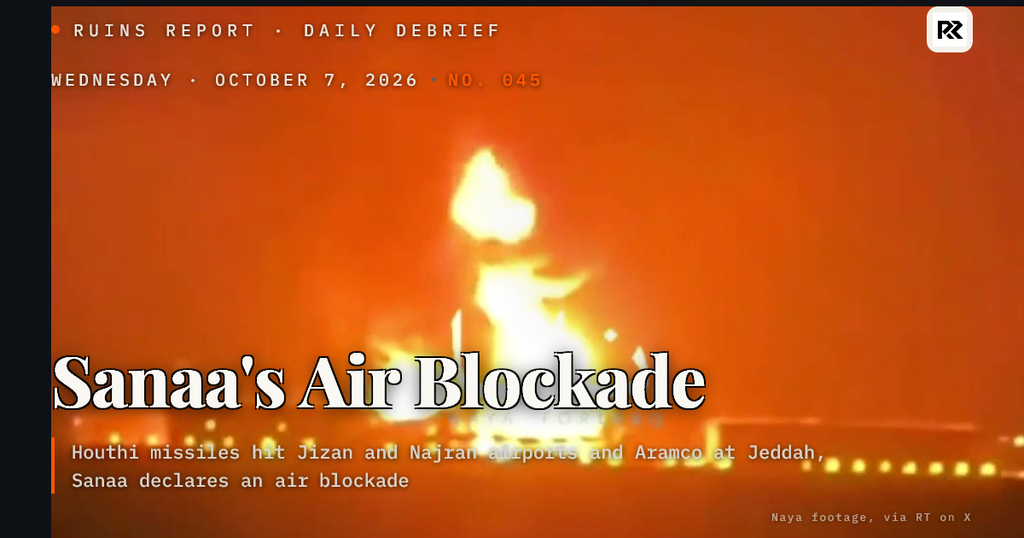
Houthi ballistic missiles have struck the airports at Jizan and Najran, and the government in Sanaa has followed the strikes with a declaration of its own: an air blockade of Saudi Arabia. Nima Alkhorshid, who carried the report on Tuesday's Dialogue Works, added a number from the ground. Forces of the Saudi-backed Presidential Leadership Council failed to take a position near Taiz, with more than 200 killed by his account, and the city is encircled.¹ To the north, the kingdom's oil was again moving less freely. "There were reports yesterday that the Saudi pipeline, which runs across Saudi Arabia and brings Saudi oil to the Red Sea, has been shut down once again," John Mearsheimer told Judge Napolitano.² Mark Sleboda, on Rachel Blevins's show, listed what Houthi missiles and drones have reached in a week: Aramco near Riyadh, Aramco at Jeddah, and a pumping station on the East-West line to Yanbu, which is now suspended.³
This is the war Riyadh chose to reopen. Since Riyadh's announced 100,000-man counteroffensive, the coalition behind it has grown: Pakistani and Turkish aircraft and Emirati help, by Mearsheimer's account, and, by Sleboda's, about 200 American intelligence and targeting personnel inside Saudi Arabia, British refuelling aircraft, and French troops and air defence, on top of the resumed US refuelling of Saudi jets. The question that followed Tuesday's reports is whether that coalition can win the war, or whether it is the mechanism by which Saudi Arabia is drawn into the larger one between the United States and Iran.
"The Saudis have decided to go to war big time against the Houthis," Mearsheimer said, and in his reading the decision ties the Yemen war to the Iran-US war rather than keeping it apart.⁴ He allowed that the Saudis can win on the ground in places. What they cannot do is end it. "Can they strategically defeat the Houthis? I think the answer is no."⁵ He expects a long war that leaves the Saudis in real trouble, and he drew the line that matters beyond the peninsula: Houthi hits on Saudi oil infrastructure could drastically cut the flow of oil out of the Gulf.⁵
Sleboda's reading is that the coalition's Western members cannot even protect the asset Riyadh cares most about. "The US and Western countries are simply not able to stop the Houthis from pummeling Saudis oil infrastructure," he said.³ Trump, he noted, declined to bomb Yemen directly, which he puts down to a shortage of standoff munitions and interceptors and to fear of Iran. The Mecca defence pact with Turkey and Pakistan he calls symbolic, a show of support whose forces will mostly stay inside the kingdom. "I just can't see Pakistani and Turkish troops marching into Yemen."⁶
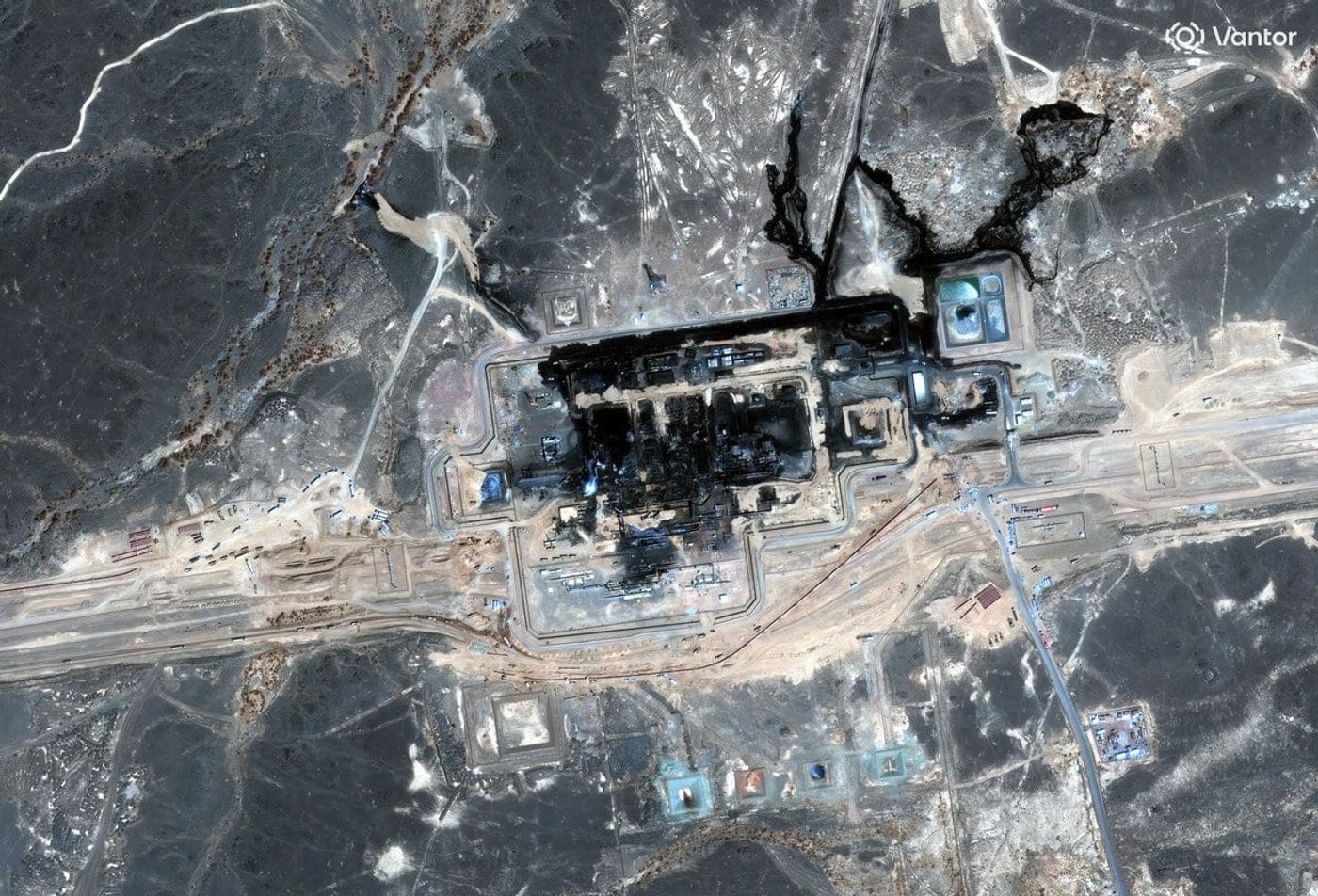
Daniel Davis took the offensive on its own terms, the "Dawn of Yemen" campaign to retake Sanaa, and found conscript Saudi forces in mountain terrain against an enemy that has held it for a decade. He also found the kingdom's first claimed success wanting. Riyadh says it has retaken Mocha; the map Davis showed still has the port in Houthi hands, which he reads as an information operation rather than a result.⁷ His guest Steve Jermy, a retired Royal Navy commodore, weighed the terrain, Houthi morale after pushing two American carrier groups out of the Red Sea, and the coalition's logistics, and reached the same place: "Saudi push to retake Sanaa seems unlikely to me."⁸ He expects a prolonged campaign or a Saudi setback.
Lawrence Wilkerson went back a step, to how the Houthis came to be in a position to besiege Taiz and close airports at all. "What Donald Trump has done by this insane, stupid, idiotic war he started in Southwest Asia is open the door for them," he said on Dialogue Works,⁹ and the Houthis have walked through it: "their ultimate strategic and political objective now is to reunify Yemen under essentially their leadership."¹⁰ He also doubts the Mecca pact is about Yemen. The Turkish-Pakistani-Saudi arrangement on arms and troops, in his reading, puts only token forces into the war to the south. "I can believe that they're positioning forces to ultimately take on Israel."¹¹
That is where the question turns. If the coalition cannot beat the Houthis and its newest members will not fight them, the Yemen front is not a war Riyadh can win on its own terms; it is a flank of the one Washington is already fighting. Sleboda says as much. Iran holds Hormuz, the Houthis hold Bab el-Mandeb, and Yemen is the periphery. In the strait, he said, "13 ships were hit in the last few days," vessels that tried to pass without coordinating with Tehran.¹²
And the center of that war is not moving. Mearsheimer dismissed the threat, now circulating in Washington, to resume strikes on Iran once the midterms are past. "We do not have a viable military option now, and there's no reason to think we're going to have a viable military option by mid November."¹³ He would bet Trump does not attack; the greater danger, he said, is Iran restarting the shooting. Jermy, from a career at sea, arrived at the same conclusion by a different road: "I cannot see a military solution which results in the defeat of Iran unless Jack Keane has got some special super duper weapon. The only thing I can see is the disaster of nuclear weapons."¹⁴
So the read on Tuesday was consistent across four shows. Riyadh can take ground and still lose the war; its new allies will garrison the kingdom rather than cross into Yemen; the Western members of the coalition cannot shield the pipeline or the airports; and each missile that lands on Aramco binds the Saudi campaign more tightly to the American one against Iran. Where the analysts differed was only on what the Mecca pact is for: a symbolic show, in Sleboda's phrase, or, in Wilkerson's suspicion, the first positioning of forces for a different war altogether.
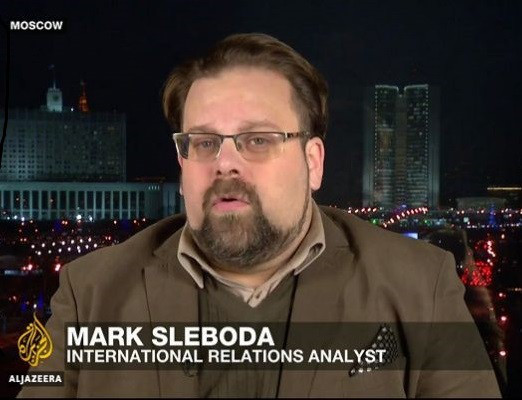
“The US and Western countries are simply not able to stop the Houthis from pummeling Saudis oil infrastructure”
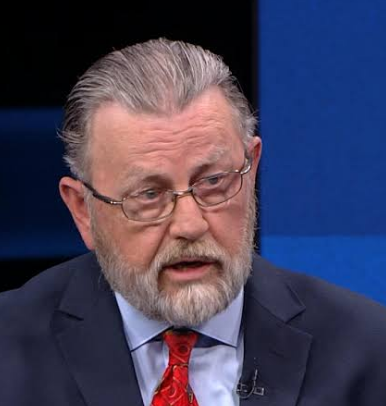
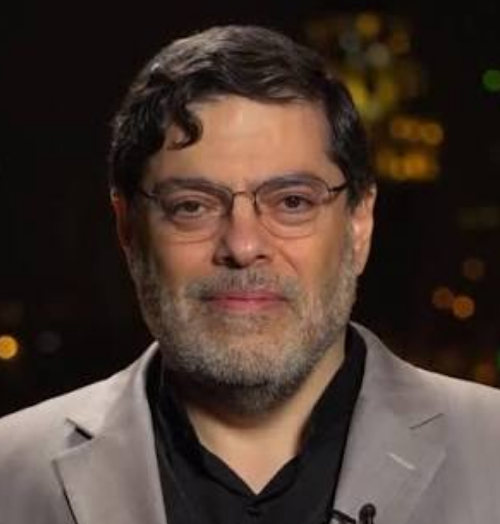
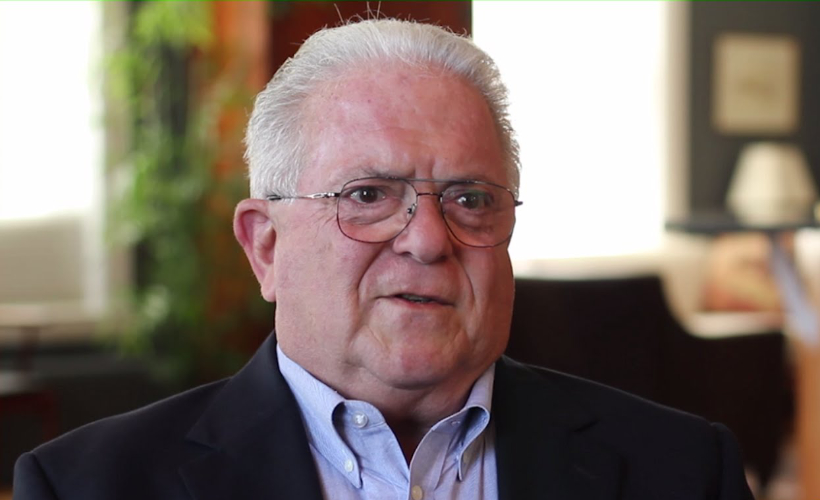
An expendable city, a Heathrow detention and Modi's ceasefire line
Donald Trump told a rally that Iran taking out Los Angeles or San Diego would be a small price to pay for the war, a remark that ran through Judge Napolitano's programme on Tuesday. Chas Freeman gave the shortest answer to it: "no president should declare any part of the American population expendable."¹⁵
Ian Proud, the former British diplomat, was held for three hours at Heathrow under the Counter-Terrorism and Border Security Act 2019 on his return from the Valdai conference in Russia; his devices were seized and no charge followed. "I'm still arrested for 3 hours, having notified the government, having consulted the previous ambassador to Moscow," he said on Neutrality Studies.¹⁶
Narendra Modi has floated a ceasefire on the current lines in Ukraine, and Alexander Mercouris on The Duran placed it where it belongs: "it's for a freeze of the conflict and a ceasefire along the existing conflict lines. In other words, exactly the same proposal that has been made by the Ukrainians, by the Americans, it's now being taken up by the Indians."¹⁷ He reads Dmitry Medvedev's "Istanbul plus" minimum and Dmitry Peskov's vow to fight for every millimetre as Moscow's answer, and the answer is no.
Sources
- Nima Alkhorshid, Dialogue Works · Houthi missiles hit Jizan and Najran airports, Sanaa declares an air blockade, PLC forces fail near Taiz with more than 200 killed, Taiz encircled · watch ▶
- John Mearsheimer, Judging Freedom (Judge Napolitano) · "the Saudi pipeline, which runs across Saudi Arabia and brings Saudi oil to the Red Sea, has been shut down once again" · watch ▶ 24:09
- Mark Sleboda, Rachel Blevins · Houthi strikes on Aramco near Riyadh, Jeddah and the East-West pumping station; "the US and Western countries are simply not able to stop the Houthis from pummeling Saudis oil infrastructure" · watch ▶ 32:24
- John Mearsheimer, Judging Freedom (Judge Napolitano) · "the Saudis have decided to go to war big time against the Houthis" · watch ▶ 20:23
- John Mearsheimer, Judging Freedom (Judge Napolitano) · "Can they strategically defeat the Houthis? I think the answer is no." · watch ▶ 23:07
- Mark Sleboda, Rachel Blevins · "I just can't see Pakistani and Turkish troops marching into Yemen" · watch ▶ 32:10
- Daniel Davis, Daniel Davis / Deep Dive · the "Dawn of Yemen" offensive is unlikely to work in mountain terrain with conscript forces; the Mocha claim looks like an information operation · watch ▶
- Steve Jermy, Daniel Davis / Deep Dive · "Saudi push to retake Sanaa seems unlikely to me" · watch ▶
- Lawrence Wilkerson, Dialogue Works · "what Donald Trump has done by this insane, stupid, idiotic war he started in Southwest Asia is open the door for them" · watch ▶ 7:21
- Lawrence Wilkerson, Dialogue Works · "their ultimate strategic and political objective now is to reunify Yemen under essentially their leadership" · watch ▶ 7:37
- Lawrence Wilkerson, Dialogue Works · "I can believe that they're positioning forces to ultimately take on Israel" · watch ▶ 24:58
- Mark Sleboda, Rachel Blevins · "13 ships were hit in the last few days" in Hormuz, attempting to pass without coordinating with Iran · watch ▶ 36:58
- John Mearsheimer, Judging Freedom (Judge Napolitano) · "We do not have a viable military option now, and there's no reason to think we're going to have a viable military option by mid November." · watch ▶ 18:05
- Steve Jermy, Daniel Davis / Deep Dive · "I cannot see a military solution which results in the defeat of Iran unless Jack Keane has got some special super duper weapon." · watch ▶ 16:33
- Chas Freeman, Judging Freedom (Judge Napolitano) · "no president should declare any part of the American population expendable" · watch ▶ 25:48
- Ian Proud, Neutrality Studies · "I'm still arrested for 3 hours, having notified the government, having consulted the previous ambassador to Moscow." · watch ▶ 1:53
- Alexander Mercouris, The Duran · Modi's ceasefire is "exactly the same proposal that has been made by the Ukrainians, by the Americans" · watch ▶ 2:59
By Ruins Report, a daily synthesis of what our tracked analysts said, not original reporting. Every numbered claim is sourced, dated, and timestamped above.
Newsletter
Get the Daily Debrief
One email each morning: what the analysts we track actually said, and every call timestamped to its source. Free.
Free. No spam. View on Substack →
Support the Report
Free to read, every day.
The Debrief is compiled each morning from what the analysts we track actually said, sourced and timestamped. No paywall, no ads, no investors. If it earns a place in your inbox, you can help keep it independent.
Support the report →