
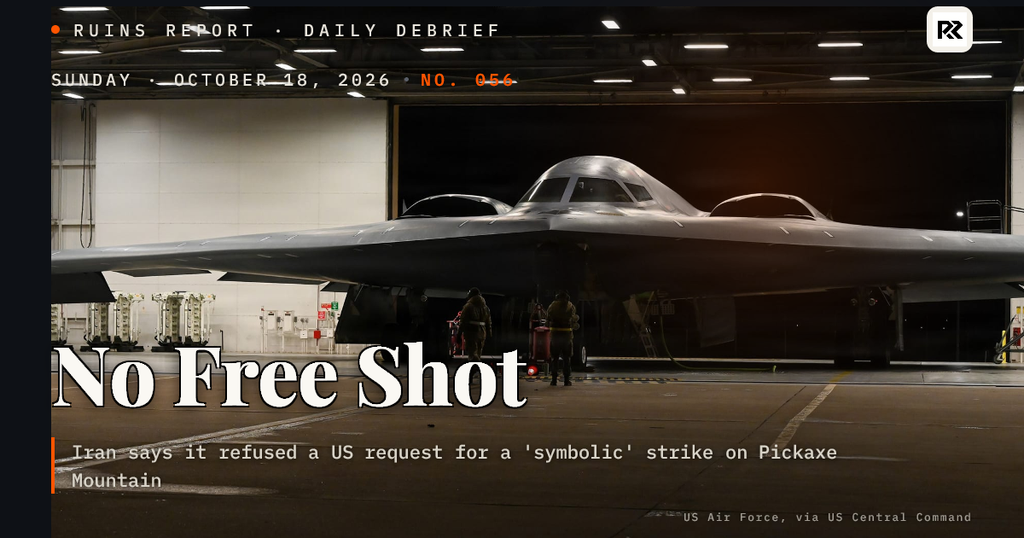
Iran's state media says that Washington, working through intermediaries, asked Tehran to permit a "symbolic" strike on the Pickaxe Mountain nuclear facility on the understanding that Iran would not retaliate, and that Tehran turned the request down. As the report was read on air: "The United States has asked Iran to allow a symbolic strike on its Pickaxe Mountain nuclear facility with no Iranian retaliation. The offer was rejected."¹
The request, if it was made, is the natural next step from the MOAB plan CNN reported on Thursday 15 October: strike fast, pull out, declare victory. The president has not been coy about the target. On Newsmax he said: "Now we're looking at Pickaxe Mountain. We may have to go there. We'll take a shot at that one. We'll knock it out fast." Asked whether that meant troops on the ground: "No, I don't see that."²
Mark Sleboda takes the Iranian account at face value. The administration, as he reads it, "requested permission to drop a MOAB on Pickaxe Mountain for symbolic reasons and then declare victory and probably not go home but at least wait till after the midterm elections," and he sees nothing implausible in that: "This actually tracks. There is absolutely no reason to question this."³ Brandon Weichert, putting the same story to Mark Cancian, framed it as a president who "would happily replicate the ending of the 12-day war where he does this dazzling pyrotechnics display, does some damage, gets to call a win, and then gets out," and who had now been told no.⁴
Steve Hanke does not believe it. "The report is so screwy that I don't believe it. I mean, who in the world would ask for something like that? Let me drop a bomb on you. And by the way, you can't shoot back."⁵ He allows that one should never underestimate Washington, but calls this one beyond the pale. The dissent is about provenance, not about the bomb. On the bomb Hanke is as blunt as anyone: "the mother of all bombs thing is a loser of the highest possible order," because it is doubtful it can penetrate the key sites and, even if it could, Iran retains the capacity to answer against the Gulf.⁶
Whether or not the request was made, the arithmetic behind it is not in dispute, and Cancian, who has spent a career on the Pentagon's stockpiles, supplied it. The show sold the hour as nineteen years of Patriot missiles fired in seven months; Cancian's own account was narrower and worse. "We have lots of the 2,000 lb bombs, but for something like Pickaxe Mountain or the Isfahan facility or Natanz, you had to go with one of these very large ones. And for Pickaxe Mountain, not clear that even the largest, the mother of all bombs, will have an effect."⁷ The deeper problem is industrial. "We intentionally designed our defense industry for short wars, and now we're in a long war," he said, and production, though rising, is "not where we need it to be," leaving "this window of vulnerability when our munition stocks are way low."⁸
“We intentionally designed our defense industry for short wars, and now we're in a long war.”
John Mearsheimer made the same point from the other end of the calendar. "Between February 28th and April 8th of this year, we waged a 40-day bombing campaign against Iran and it failed. How could anybody possibly believe that a three-day bombing campaign is going to do what a 40-day bombing campaign couldn't do?"⁹ The ground option that might change that answer does not exist, in KJ Noh's view: the United States "cannot do boots on the ground. It simply doesn't have the manpower and it would take at least a year to stage that manpower and to do a meaningful incursion."¹⁰ The president said as much himself.
So the strike that remains is not one that changes the facts under the mountain. It is one that changes the headline, and the reported request was an attempt to buy that headline at no cost. Tehran's refusal, if the account holds, removes the costless version. The costly version is still on the table because Washington cannot leave the table. Cancian: "The thing that's hanging over all of this is the Strait of Hormuz, and the fact that it is at least partly blocked. Sometimes ships get through, sometimes they don't. And as long as it's partly blocked, Trump can't just walk away because of the effect on US gas prices and the world economy."¹¹ Sleboda reaches the same place by a harder road: "They can't accept an Iran in control of the Strait of Hormuz, because there's no way that they can spin that, no matter how desperately they've been trying, as them winning this war against Iran. So they're going to have to have at least one more roll of the dice."¹² Noh adds that the relative calm of the past weeks "is because of Iran's restraint," and that Iran "can certainly release some of that restraint," as the tanker strikes of recent days show.¹³
That is why the argument has moved from whether to when. Cancian puts the odds at "probably two-thirds chances that he will go that way, and one-third that he'll go with some sort of negotiation," and he means after the midterms.¹⁴ Of a strike on Pickaxe Mountain in particular, probably with a MOAB at the entrances, in the middle of nowhere and with the pyrotechnics the president likes: "I think the chances of that are pretty high."¹⁵ Sleboda's version of the reported request itself had the date built in: declare victory, and "at least wait till after the midterm elections."³
The temptation is to read the delay as nerve failing. The better reading, on this evidence, is that the will is intact and the means are not. A strike before 3 November risks the oil price the White House is working to hold down; a strike after it, with the stockpile Cancian describes, can raise Iran's costs and lengthen its timeline but cannot end the program. Washington wanted a strike that would cost it nothing, neither retaliation nor a cent at the pump. Tehran declined to supply one, and the munitions and the gas price, rather than anyone's intentions, now set the calendar.
Encirclement south of Slavyansk, 70 percent of the world's ships and a spy agency that knows
Alexander Mercouris, reviewing the Donbass front on Saturday 17 October, treats the fall of Dobropolye as settled: "I have no doubt that Dobropolye has indeed fallen."¹⁶ With Russian forces also inside Druzhkovka and taking ground further north, he reads the map as something larger than a town: "The encirclement of the southern parts of the Slavyansk agglomeration has begun."¹⁷ When Druzhkovka goes and the battle for Kramatorsk begins in earnest, he expects the Ukrainian position there to become critical.¹⁷
Sal Mercogliano put numbers on the shipbuilding gap that sits under every American naval plan. "China just last year in 2025 produced over 50% of all ships and they're on track to build over 70% in 2026. The US meanwhile, in terms of commercial shipbuilding, builds 0.3%."¹⁸ The current program, he says, is heavy on the Navy and on drones and light on the merchant yards that everything else rests on: "It's commercial shipbuilding that builds your base. It builds your infrastructure."¹⁹
Ulrike Guérot, speaking on Neutrality Studies, declined to end on a hopeful note. "I'm 62 years old. I have never seen the European continent at large in such bad shape."²⁰ The war, in her account, is already understood to be lost inside the German state even as the European Parliament votes for more of it: "I'm totally convinced that the BND also knows that this war is lost."²¹
Sources
- Report relayed on air, Dialogue Works · Iranian state media: the US asked Iran to allow a symbolic strike on Pickaxe Mountain with no Iranian retaliation; the offer was rejected · watch ▶ 1:26
- Donald Trump, Dialogue Works (Newsmax clip played on air) · "Now we're looking at Pickaxe Mountain. We may have to go there. We'll take a shot at that one. We'll knock it out fast." No troops on the ground · watch ▶ 1:05
- Mark Sleboda, Dialogue Works · The administration "requested permission to drop a MOAB on Pickaxe Mountain for symbolic reasons," then declare victory and "wait till after the midterm elections"; "this actually tracks" · watch ▶ 2:30
- Brandon Weichert, Mario Nawfal · Trump "would happily replicate the ending of the 12-day war where he does this dazzling pyrotechnics display, does some damage, gets to call a win, and then gets out"; the Iranians said no · watch ▶ 12:20
- Steve Hanke, Dialogue Works · "The report is so screwy that I don't believe it. Let me drop a bomb on you. And by the way, you can't shoot back." · watch ▶ 42:32
- Steve Hanke, Dialogue Works · "The mother of all bombs thing is a loser of the highest possible order"; doubtful it can penetrate, and Iran can answer against the Gulf regardless · watch ▶ 29:01
- Mark Cancian, Mario Nawfal · Plenty of 2,000 lb bombs, but Pickaxe Mountain, Isfahan and Natanz need the very large ones, and "for Pickaxe Mountain, not clear that even the largest, the mother of all bombs, will have an effect" · watch ▶ 4:51
- Mark Cancian, Mario Nawfal · "We intentionally designed our defense industry for short wars, and now we're in a long war"; production is "not where we need it to be" and "we have this window of vulnerability when our munition stocks are way low" · watch ▶ 47:09
- John Mearsheimer, Glenn Diesen · "How could anybody possibly believe that a three-day bombing campaign is going to do what a 40-day bombing campaign couldn't do?" · watch ▶ 49:09
- KJ Noh, Danny Haiphong · The US "cannot do boots on the ground. It simply doesn't have the manpower and it would take at least a year to stage that manpower" · watch ▶ 3:17
- Mark Cancian, Mario Nawfal · Hormuz is at least partly blocked, and "as long as it's partly blocked, Trump can't just walk away because of the effect on US gas prices and the world economy" · watch ▶ 13:24
- Mark Sleboda, Dialogue Works · "They can't accept an Iran in control of the Strait of Hormuz because there's no way that they can spin that as them winning this war"; "at least one more roll of the dice" · watch ▶ 20:22
- KJ Noh, Danny Haiphong · The relative stability "is because of Iran's restraint," and Iran "can certainly release some of that restraint," as the tanker strikes show · watch ▶ 2:37
- Mark Cancian, Mario Nawfal · "Probably two-thirds chances that he will go that way and one-third that he'll go with some sort of negotiation," after the midterms · watch ▶ 16:30
- Mark Cancian, Mario Nawfal · A MOAB strike on Pickaxe Mountain, in the middle of nowhere with the pyrotechnics the president likes: "I think the chances of that are pretty high" · watch ▶ 15:25
- Alexander Mercouris, Alexander Mercouris · "I have no doubt that Dobropolye has indeed fallen" · watch ▶ 9:15
- Alexander Mercouris, Alexander Mercouris · Russians inside Druzhkovka and advancing north of it: "The encirclement of the southern parts of the Slavyansk agglomeration has begun" · watch ▶ 28:53
- Sal Mercogliano, What's Going on With Shipping? · China built over 50% of all ships in 2025 and is on track for over 70% in 2026; the US builds 0.3% commercially · watch ▶ 0:47
- Sal Mercogliano, What's Going on With Shipping? · "It's commercial shipbuilding that builds your base. It builds your infrastructure." · watch ▶ 27:32
- Ulrike Guérot, Neutrality Studies · "I'm 62 years old. I have never seen the European continent at large in such bad shape." · watch ▶ 48:42
- Ulrike Guérot, Neutrality Studies · "I'm totally convinced that the BND also knows that this war is lost." · watch ▶ 52:40
By Ruins Report, a daily synthesis of what our tracked analysts said, not original reporting. Every numbered claim is sourced, dated, and timestamped above.
Newsletter
Get the Daily Debrief
One email each morning: what the analysts we track actually said, and every call timestamped to its source. Free.
Free. No spam. View on Substack →
Support the Report
Free to read, every day.
The Debrief is compiled each morning from what the analysts we track actually said, sourced and timestamped. No paywall, no ads, no investors. If it earns a place in your inbox, you can help keep it independent.
Support the report →