
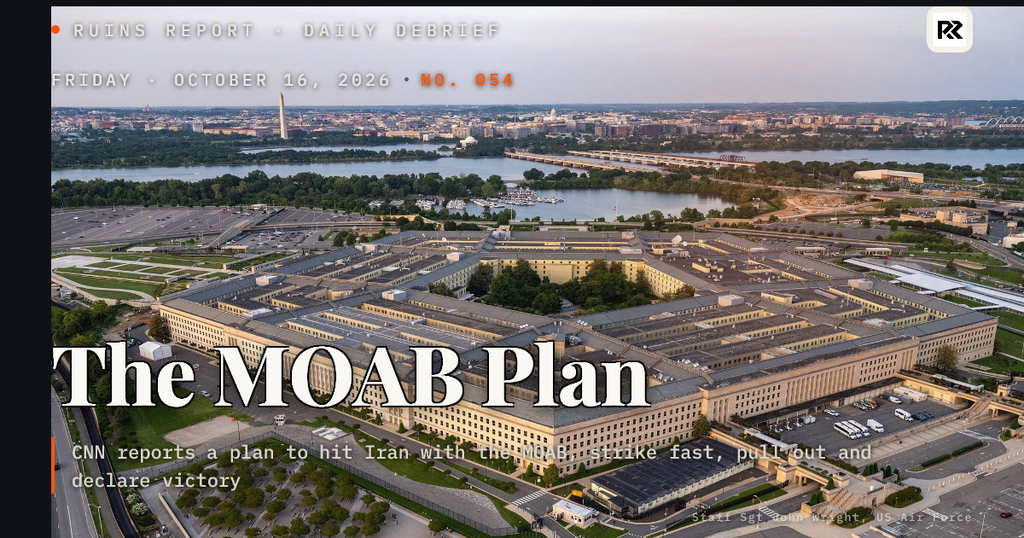
CNN, citing American officials, reported on Thursday 15 October that the Pentagon has a plan to strike Iran with the GBU-43/B, the Massive Ordnance Air Blast bomb, "the most destructive non-nuclear bomb in the United States inventory"; one source told the network that Central Command intends to "conduct the strikes quickly then pull out and declare victory," as Nima Alkhorshid read the report on air.¹ Iran has placed its armed forces on a 72-hour alert,² and Israel's Channel 12 reported that Israel believes Iran may be preparing a preemptive attack after Western intelligence detected what it described as extreme military movements inside the country.³ On the campaign trail on 13 October, Trump told a crowd to "wait till you see what we do to Iran."⁴ Israel votes on Tuesday 27 October and the United States on Tuesday 3 November. A week after a three-day bombing plan was reported and ruled out before the midterms, the plan now described is smaller and more theatrical: one bomb heavy enough to look like an ending, dropped fast enough to be over before the polls open. The question it raises is whether a war being fought at sea can be ended from the air.
The sea is where the week's facts are. By Daniel Davis's count, 88 ships have been hit or destroyed since the war began, 50 of them since the United States reimposed its blockade on 14 July, and two more cargo ships went down in the 24 hours before his Thursday programme.⁵ Elijah Magnier described a change in method: Iran has moved from drones to surface-to-surface and cruise missiles against tankers under American escort, and on one day this week mounted as many as a dozen attacks in the Strait.⁶ In his reading the intent is no longer deterrence. "Iran is no longer sending a warning, it is a sheer provocation to bring the US into the war,"⁷ timed to the American election. What strikes him is that the provocation has not yet worked. "Donald Trump is not falling into this trap, but he's talking and he's screaming and he's doing interviews,"⁸ and of the MOAB threat itself: "it's like popcorn, a lot of volume but empty inside."⁹
Mohammad Marandi does not treat the threat as empty, and neither, he says, does the government in Tehran. Of the pledge not to strike before the midterms: "Iran doesn't believe anything that he says,"¹⁰ and the country is planning for an attack before election day. Schools on the Gulf islands and in parts of the coast have been moved online as a precaution.¹¹ Asked what a single MOAB strike would bring, he said the consequence was "clear as day":¹² Iran would go all out against every American-linked asset in the Gulf, and the loss of Gulf oil and gas "will bring about a great depression very very swiftly."¹³ The monarchies, in his telling, cannot absorb it. "If Iran begins to take out the infrastructure of Saudi Arabia or the Emirates or Qatar, it'll be over in a day."¹⁴ As for the waterway the strike is meant to reopen, "the Iranians are fully in control of the Strait of Hormuz."¹⁵
Daryl Cooper's objection is narrower and, for a planner at Central Command, harder to answer. Iran, by his count, has "blown the hell out of our Reaper fleet, last count confirmed they were up to almost four dozen,"¹⁶ and he put the problem in operational terms: "if you can't fly fleets of B-52s over that country unimpeded, how are you going to escalate the war?"¹⁷ He walked through a visual investigation of 135 Iranian strikes on about 80 Gulf sites that found precise targeting of LNG cooling equipment and power generators, evidence that the other side's reach is intact.¹⁸ His conclusion was that there is no rung left on the ladder: "the idea that we have an escalatory card short of nuclear weapons that we have not used is just completely ridiculous."¹⁹
Put the three together and the plan reads less as a military operation than as a political one, and that is how Tim Miller reads it. "There's no face saving way out for him,"²⁰ he said of Trump, and his most likely scenario is the one CNN describes: "he does some other dramatic, you know, Moab bombing or, you know, shock and awe style bombing and then and then calls it a victory,"²¹ followed by a bad deal and a withdrawal. Cooper cited a Fox News poll that ranks the Iran war above immigration among voters' concerns, behind corruption, inflation and the price of fuel.²² The bomb is addressed to those voters. What it cannot address, in Miller's account, is the position the war leaves behind: "you end up in a situation where Iran is more powerful, more influential in the region than they've been in a quarter century."²³




The deeper problem is that the instrument is being chosen for its size, and size is not what this war has turned on. Chris Martenson's case rests on quantities that no single strike changes. A barrel of dated Brent, he said, costs "about $150, $145 right now to buy it,"²⁴ whatever the futures screen shows. "Qatar was 20% of the world's daily surface allotment of LNG before the war. Since the war, that number is zero."²⁵ On the blockade's claim to have restored order in the Strait: "You can't block 10% and say we're back to normal."²⁶ He measures the asymmetry in budgets, "about 8 billion against 880 billion for the US, a 100 to 1 asymmetry, and they fought us to a standstill,"²⁷ and his forecast for a renewed heavy attack is the regional war the planners say they want to avoid: "I would predict that we would see the whole region just kind of go up in flames at that point,"²⁸ with what remains of Gulf exports going to zero. His baseline, absent a decision to walk away, is not an ending at all: "the war is going to drag on. It's going to actually escalate at certain points."²⁹
A bomb that can be dropped and declared a victory before 3 November would have to land on something that decides the war, and nothing in Thursday's episodes identified such a target. The analysts we track place the war's weight at sea and in the price of what passes through the Strait, where Magnier expects Iran to go on imposing costs "for the next 2 years"³⁰ and where Marandi and Martenson both expect a strike to turn a shipping war into a Gulf-wide one. The CNN report, read that way, describes a plan to leave the war rather than a plan to end it, and the two are not the same thing.

“The idea that we have an escalatory card short of nuclear weapons that we have not used is just completely ridiculous.”
A Starlink squeeze on Kiev, a second Saudi jet hit and Gaza's aid blocked
Reports relayed on Mario Nawfal's broadcast have Washington restricting Starlink and threatening to withhold intelligence to press Zelensky toward Putin's territorial terms,³¹ with Zelensky in London and Brussels in search of cover. Michael von der Schulenburg, a former UN official now in the European Parliament, told Daniel Davis that the betrayal Ukrainians will remember is not the one being described in Kiev: "Those who betrayed them is not Russia. What betrayed them is Western Europe."³²
After the strike on Aramco's headquarters, Yemen published footage of a second Saudi jet, a Eurofighter Typhoon, hit. Scott Ritter drew the largest conclusion yet put to it: "We are witnessing, I believe, the fall of the house of Saud."³³
Max Blumenthal said that on 15 October the Board of Peace's director general, Nikolai Mladenov, blocked all aid into Gaza on behalf of COGAT, with Israel's vote ten days away. "The yellow line has moved from 40% of the Gaza Strip to now, as Netanyahu has boasted, close to 70%,"³⁴ he said, and of the body meant to administer the ceasefire: "Israel calls the shots and the Board of Peace is actually a propaganda mechanism for Israel."³⁵
Sources
- Nima Alkhorshid, Dialogue Works · CNN, citing US officials, reported a plan to strike Iran with the GBU-43/B MOAB, "the most destructive non-nuclear bomb in the United States inventory"; one source said Central Command plans to "conduct the strikes quickly then pull out and declare victory" · watch ▶ 0:59
- Report read on air, Mario Nawfal (hosted by Brandon Ward) · Iran raised its military alert for 72 hours · watch ▶ 1:37
- Mario Nawfal, Mario Nawfal · Israel's Channel 12 reported Israel believes Iran may be preparing a preemptive attack after Western intelligence detected extreme military movements inside Iran · watch ▶ 1:06
- Clip played on air, Judging Freedom · Trump on the campaign trail, 13 October: "wait till you see what we do to Iran" · watch ▶
- Daniel Davis, Daniel Davis / Deep Dive · His own count: 88 ships hit or destroyed since the war began, 50 since the blockade was reimposed on 14 July; two more cargo ships sunk in the last 24 hours · watch ▶
- Elijah Magnier, Rachel Blevins · Iran has shifted from drones to surface-to-surface and cruise missiles against US-escorted tankers, with up to 12 attacks in the Strait in a single day · watch ▶
- Elijah Magnier, Rachel Blevins · "Iran is no longer sending a warning, it is a sheer provocation to bring the US into the war" · watch ▶ 6:01
- Elijah Magnier, Rachel Blevins · "Donald Trump is not falling into this trap, but he's talking and he's screaming and he's doing interviews" · watch ▶ 6:17
- Elijah Magnier, Rachel Blevins · On the MOAB threats: "it's like popcorn, a lot of volume but empty inside" · watch ▶ 6:27
- Mohammad Marandi, Judging Freedom · Iran expects an attack before election day despite Trump's pledge: "Iran doesn't believe anything that he says" · watch ▶ 11:07
- Mohammad Marandi, Judging Freedom · Iranian schools on the islands and some coastal areas have moved online as a precaution · watch ▶
- Mohammad Marandi, Judging Freedom · On a US MOAB strike: "if that happens, judge, I think it's clear as day what will happen" · watch ▶ 3:44
- Mohammad Marandi, Judging Freedom · Iranian retaliation ending Gulf oil and gas supply "will bring about a great depression very very swiftly" · watch ▶ 4:06
- Mohammad Marandi, Judging Freedom · "if Iran begins to take out the infrastructure of Saudi Arabia or the Emirates or Qatar, it'll be over in a day" · watch ▶ 6:58
- Mohammad Marandi, Judging Freedom · "the Iranians are fully in control of the Strait of Hormuz" · watch ▶ 15:38
- Daryl Cooper, Provoked · "they blown the hell out of our Reaper fleet, last count confirmed they were up to almost four dozen" · watch ▶ 76:09
- Daryl Cooper, Provoked · "if you can't fly fleets of B-52s over that country unimpeded, how are you going to escalate the war?" · watch ▶ 72:56
- Daryl Cooper, Provoked · A visual investigation of 135 Iranian strikes on about 80 Gulf sites shows precision targeting of LNG cooling equipment and power generators · watch ▶
- Daryl Cooper, Provoked · "the idea that we have an escalatory card short of nuclear weapons that we have not used is just completely ridiculous" · watch ▶ 77:44
- Tim Miller, Mario Nawfal · "there's no face saving way out for him" · watch ▶ 5:20
- Tim Miller, Mario Nawfal · Most likely scenario: "he does some other dramatic, you know, Moab bombing or, you know, shock and awe style bombing and then and then calls it a victory", then a bad deal and withdrawal · watch ▶ 22:45
- Daryl Cooper, Provoked · Fox News poll: top voter concerns are political corruption, inflation and high gas prices, with the Iran war ranked above immigration · watch ▶
- Tim Miller, Mario Nawfal · "you end up in a situation where Iran is more powerful, more influential in the region than they've been in a quarter century" · watch ▶ 26:25
- Chris Martenson, Daniel Davis / Deep Dive · "If you want to buy a barrel of dated Brent today, it's about $150, $145 right now to buy it" · watch ▶ 5:19
- Chris Martenson, Daniel Davis / Deep Dive · "Qatar was 20% of the world's daily surface allotment of LNG before the war. Since the war, that number is zero." · watch ▶ 8:09
- Chris Martenson, Daniel Davis / Deep Dive · "You can't block 10% and say we're back to normal." · watch ▶ 4:22
- Chris Martenson, Daniel Davis / Deep Dive · Iran's budget of about 8 billion against 880 billion for the US, "a 100 to 1 asymmetry, and they fought us to a standstill" · watch ▶ 37:14
- Chris Martenson, Daniel Davis / Deep Dive · If the US attacks Iran hard again: "I would predict that we would see the whole region just kind of go up in flames at that point", with Gulf exports back to zero · watch ▶ 27:06
- Chris Martenson, Daniel Davis / Deep Dive · "the war is going to drag on. It's going to actually escalate at certain points" · watch ▶ 32:21
- Elijah Magnier, Rachel Blevins · Iran will keep imposing costs on global shipping: "this what Iran can do and will continue doing it for the next 2 years" · watch ▶ 15:04
- Mario Nawfal, Mario Nawfal · Trump reportedly pressing Zelensky to accept Putin's territorial terms, with Starlink restrictions and a threat to withhold intelligence · watch ▶
- Michael von der Schulenburg, Daniel Davis / Deep Dive · "Those who betrayed them is not Russia. What betrayed them is Western Europe." · watch ▶ 16:49
- Scott Ritter, Garland Nixon · "We are witnessing, I believe, the fall of the house of Saud." · watch ▶ 53:58
- Max Blumenthal, Judging Freedom · "The yellow line has moved from 40% of the Gaza Strip to now, as Netanyahu has boasted, close to 70%" · watch ▶ 4:08
- Max Blumenthal, Judging Freedom · "Israel calls the shots and the Board of Peace is actually a propaganda mechanism for Israel" · watch ▶ 5:56
By Ruins Report, a daily synthesis of what our tracked analysts said, not original reporting. Every numbered claim is sourced, dated, and timestamped above.
Newsletter
Get the Daily Debrief
One email each morning: what the analysts we track actually said, and every call timestamped to its source. Free.
Free. No spam. View on Substack →
Support the Report
Free to read, every day.
The Debrief is compiled each morning from what the analysts we track actually said, sourced and timestamped. No paywall, no ads, no investors. If it earns a place in your inbox, you can help keep it independent.
Support the report →