
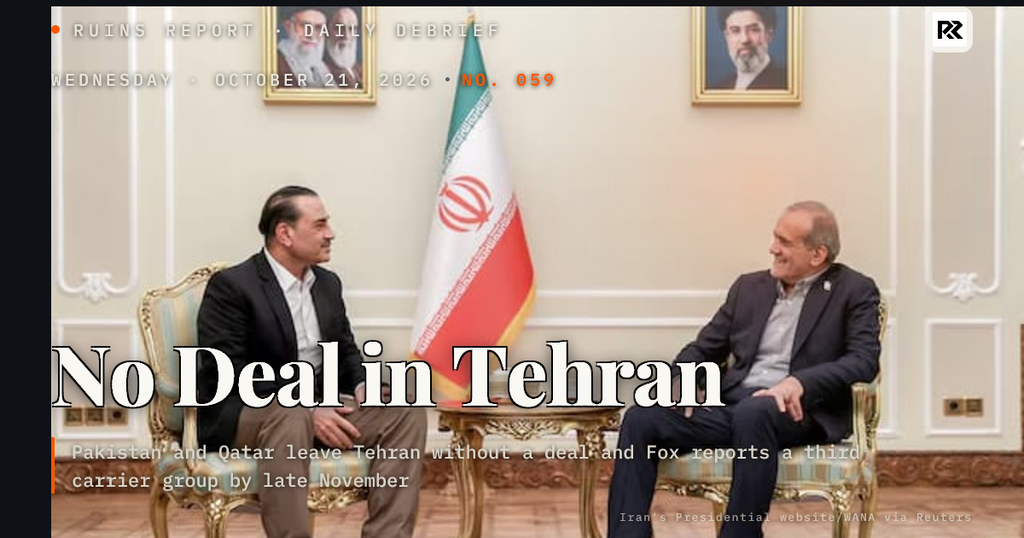
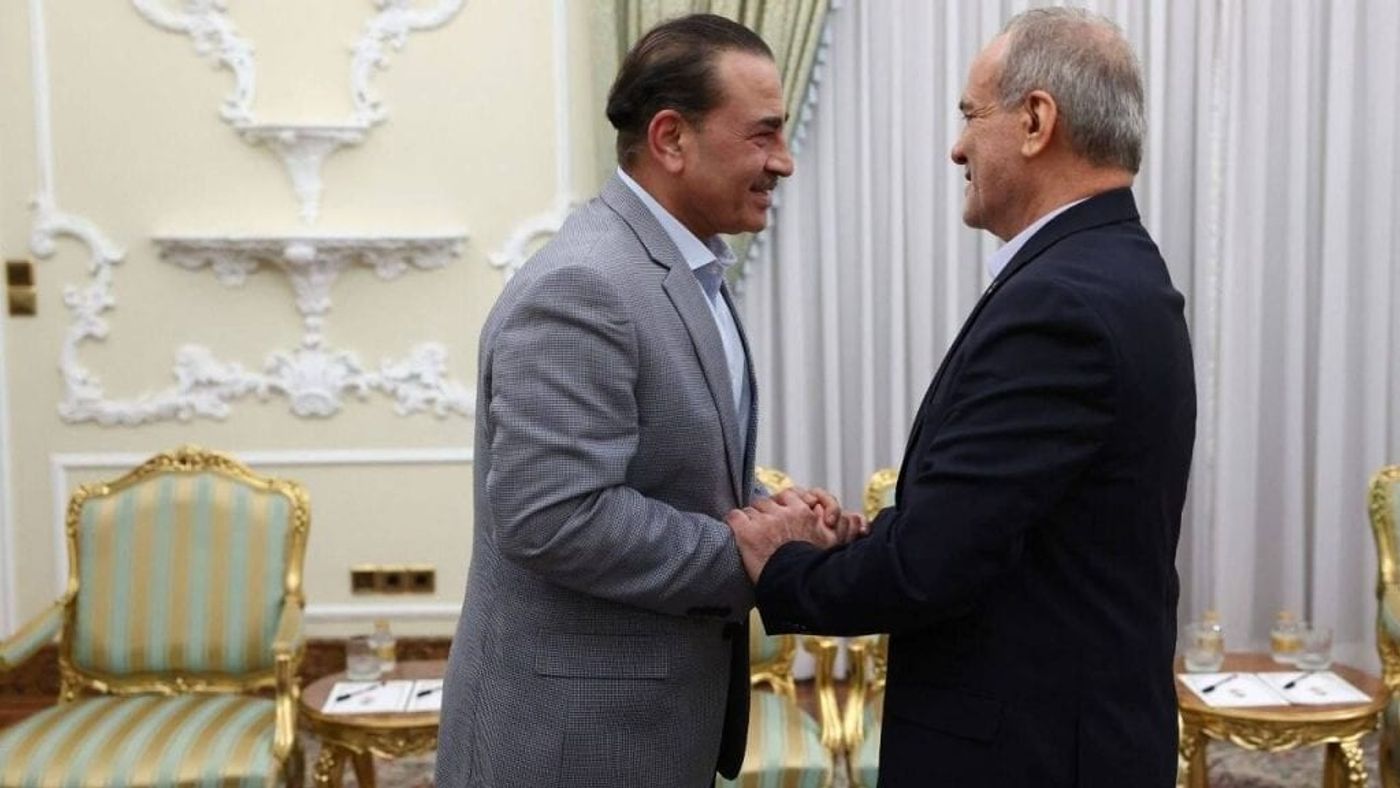
The compromise that Qatar and Pakistan carried into Tehran came back out on Tuesday 20 October without a deal, and for about an hour the oil market believed otherwise. Israel's Channel 12, citing Qatari media, reported that the proposal Field Marshal Asim Munir had presented in Tehran that day carried American approval and had won preliminary Iranian agreement, as Mario Nawfal relayed it,¹ and that Iran had agreed as part of it to a secret, unannounced IAEA visit to its nuclear facilities; crude fell from about 113 to 107 dollars within minutes of the report and was back near 110 within the hour, once the claim was denied.² The denial came from an Iranian official who said nothing had been accepted, as Danny Haiphong relayed it,³ and none of the reported terms has been confirmed by either government. The same day produced footage of Munir, Pakistan's army chief, embracing the head of Iran's national security council, and a statement from Mohsen Rezaei, as Nima Alkhorshid read it out, that not a particle of enriched nuclear material will leave Iran until the United States has built trust; Tehran, by that account, has seven demands of its own, set out in the table below.⁴ Fox News, Alkhorshid added, reports that a third carrier group, led by the USS Theodore Roosevelt, and a Marine unit will reach the region by the end of November, and oil ended the day down from about 112 to about 106 dollars.⁵
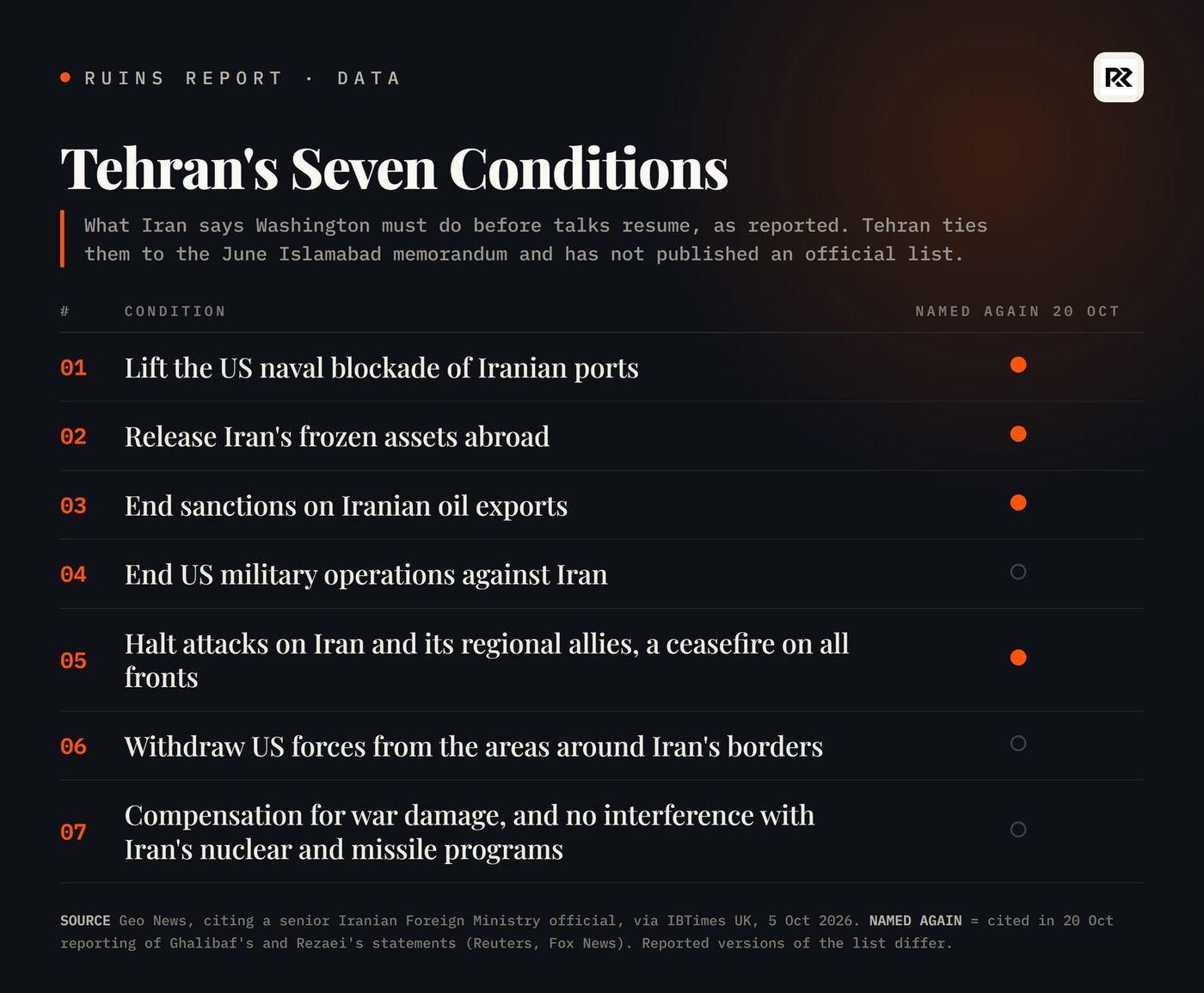
That is where the week stands after Hegseth's unannounced visit to Netanyahu: a photograph of an embrace, Rezaei's refusal to let any enriched material leave Iran, and a third carrier group on its way. The mediation did not fail for want of mediators. It failed because the two sides are no longer bargaining over the same terms: the proposal Munir carried concerned Iran's nuclear program, and Tehran's reply was seven demands of its own. The question that John Mearsheimer, Larry Johnson, Patrick Henningsen and Larry Wilkerson each approached from a different side was what Washington does when the diplomatic track closes and the military one has already been tried. Does it have an exit at all, and if not, what follows?
Mearsheimer's answer is that the exit exists and has existed since June. Trump signed a memorandum of understanding to end the war on 17 June, he recalled, and then walked away from it in search of better terms, after a bombing campaign of forty days, from 28 February to 8 April, that failed to break Iran and left American munitions running low.⁶ "He has an exit option if he accepts basically what was in the 17 June memorandum of understanding."⁷ What stands between the president and the June memorandum is not Tehran but Washington: "Almost invariably, Trump loses and the deep state wins."⁸ The talk of dropping the mother of all bombs on Pickaxe Mountain, a plan CNN reported last week, he read as a measure of how desperate the planners have become rather than a sign of a strategy.⁹

“We have no military option here. And the fact that we're talking about dropping the mother of all bombs on Pickaxe Mountain just shows you how desperate we are.”
Johnson also sees an exit, and a president who cannot find it. "Trump's trying to find an exit ramp here and they're having trouble finding an exit ramp."¹⁰ The trouble, in his account, is that the exit has grown more expensive since the spring. "Iran's in a much stronger position in terms of the leverage here,"¹¹ and if the shooting resumes it is positioned, he said, "to really inflict some broader damage on US assets in the region than they did during the first 40 days of the war."¹² Iran's leverage is already visible in Saudi Arabia without a further shot being fired: refinery output down almost 18 percent since February, diesel and gas oil exports down 47 percent, gasoline exports down nearly 40 percent, figures Johnson took from the analyst Carl Miller.¹³ Rezaei's seven demands read differently beside the Saudi export figures. A country whose adversary's partners are losing half their fuel exports has less reason to surrender its uranium than it had in June.
Henningsen looks at the same Iranian leverage and expects air strikes rather than an exit. "I've always said that the balance of incentives is probably in favor of air strikes against Iran before the US midterms or before the Israeli elections," he said,¹⁴ and Haiphong noted reports that Israeli aircraft, at least eight F-35s and F-16s, are drilling daily in Iraqi and Syrian airspace.¹⁵ A strike, though, in Henningsen's reading, hands Tehran the easier task. "Iran doesn't have to do much in terms of propaganda. They just have to remain standing on their feet, put up a good defense and inflict some pain on Israel and the US in the region."¹⁶ He went further than the others in weighing Tehran's options, calling a preemptive Iranian strike on an American fleet he described as "a sitting duck right now" a good move on Iran's part.¹⁷
Wilkerson adds China, the factor from outside the region that makes an exit harder to reach. "I think Xi has taken the restraints that he may have expressed to Tehran off of them and said, whatever you need to do, I'm with you."¹⁸ China, in his judgment, has "thrown fully behind Iran. No way we're going to beat them."¹⁹ The cost of the war, meanwhile, is already being counted at home. By a Forbes reading of Moody's figures that he cited, the war has cost about 2,000 dollars per American so far, "not to mention the blood and other treasure."²⁰ And the head of Aramco has said the destroyed Saudi refinery and pipeline will take three to five years to repair, so the Gulf's damage will outlast whatever eventually ends the fighting.²¹
Put together, the four readings converge on a conclusion none of them would quarrel with: the exit from the Iran war is not missing, it is unaffordable in Washington's own political terms. It is the June memorandum or something near it, available now on worse terms than in June and on better terms than Washington will get in November. The split among them is over timing alone, and it is a split about Washington's nerve rather than Tehran's. Henningsen expects the strike before Israel votes on Tuesday 27 October or America does on Tuesday 3 November; Mearsheimer holds that picking a fight makes no strategic sense before the midterms and no more sense after them;²² Johnson expects the search for an exit ramp to fail and the conflict, once the votes are counted, "to heat up into a broader war than what we're seeing right now."²³
Behind the timing lies the deeper problem, which Mearsheimer stated most bluntly. "President Trump has got himself into three wars that he's going to lose,"²⁴ and the balance between Iran and its adversaries, he expects, will shift "even further in favor of the Iranians" over the next two to five years.²⁵ Johnson put it as a verdict on the whole period: the eight months since February have exposed "the limitations of US and European military power. We've seen it in Asia and we've seen it in Ukraine."²⁶ Henningsen located the cause further back still, in a sanctions regime that has for decades held down the country he called "the natural hegemon" of the Gulf, with a hundred million people and a skilled labor force.²⁷ An exit that requires Washington to accept Iran's strengthened position is the only exit on offer, and it is the one Washington has so far declined to take. The mediators can carry the terms back and forth as often as they like; whether Washington accepts them is decided in Washington, and the cost of accepting them is rising.
A plan written to be refused, a bet gone bad in Riyadh and 3,000 looted shops in France
The Financial Times reports that Washington, Kiev and the Europeans are assembling a plan that would offer Moscow a choice: a ceasefire on the current lines with no NATO membership for Ukraine, or all of Donbass with Ukraine free to join the alliance; Alexander Mercouris relayed it alongside reports that Trump has said Zelensky should step down and that Zelensky refuses.²⁸ "This plan that is being put together is a plan which it is guaranteed will fail," he said, and he expects the Russians to reject it outright.²⁹ The facts on the ground, as he put it, are meanwhile in plain sight: after Kiev's drone attack on St Petersburg, Russia returned in force to the Ukrainian capital, hitting a substation in the city's west, with unconfirmed reports of bombs on the north bridge, in what he called "a steadily escalating Russian offensive campaign against the bridges and against the electricity system."³⁰
Saudi Arabia is now taking fire from Ansar Allah, Aramco included, after Riyadh bombed Sanaa airport over a flight bound for the Iranian supreme leader's funeral, as Chas Freeman recounted it.³¹ His judgment on the kingdom's decision to tie itself to Washington's war was unsparing: "if this war goes on, it is going to hurt Saudi Arabia, and it was a bad bet on the part of Muhammad bin Salman."³²
About 3,000 French businesses were looted last Saturday, 17 October, in riots that began as student protests over school conditions, Simon Heffer said, and the latest poll he had seen put Marine Le Pen at about 30 percent against Mélenchon's 20 to 21 and Edouard Philippe's 15.³³ His call came with its hedge attached: "I think it's making it look more or less certain, I may be horribly wrong, that Marine Le Pen is going to win the election next May."³⁴
Sources
- Mario Nawfal, Mario Nawfal · Israel's Channel 12, citing Qatari media, reported that the proposal Field Marshal Asim Munir presented in Tehran on Tuesday had American approval and had received preliminary Iranian agreement · watch ▶ 5:18
- Mario Nawfal, Mario Nawfal · The reported proposal included Iranian agreement to a secret, unannounced IAEA visit to its nuclear facilities; oil fell from about 113 to 107 dollars within minutes and climbed back toward 110 within the hour once the claim was denied · watch ▶ 5:55
- Danny Haiphong, Danny Haiphong · Qatar and Pakistan reportedly handed Iran a compromise deal, briefly dropping oil prices, before an Iranian official denied accepting any deal · watch ▶
- Nima Alkhorshid, Dialogue Works · Footage of Field Marshal Asim Munir embracing the head of Iran's national security council was released on 20 October; Mohsen Rezaei tweeted that not a particle of enriched nuclear material will leave Iran until the US builds trust, and Iran has seven demands · watch ▶
- Nima Alkhorshid, Dialogue Works · Fox News reports a third carrier group, the USS Theodore Roosevelt, and a Marine unit arriving in the Middle East by the end of November; oil fell from about 112 to about 106 on 20 October · watch ▶
- John Mearsheimer, Judging Freedom · Trump signed a memorandum of understanding to end the Iran war on 17 June, then walked away from it seeking a better deal; the 40-day bombing campaign from 28 February to 8 April failed, with munitions running low · watch ▶
- John Mearsheimer, Judging Freedom · "He has an exit option if he accepts basically what was in the 17 June memorandum of understanding." · watch ▶ 17:36
- John Mearsheimer, Judging Freedom · "Almost invariably, Trump loses and the deep state wins." · watch ▶ 13:51
- John Mearsheimer, Judging Freedom · "We have no military option here. And the fact that we're talking about dropping the mother of all bombs on Pickaxe Mountain just shows you how desperate we are." · watch ▶ 30:43
- Larry Johnson, Dialogue Works · "Trump's trying to find an exit ramp here and they're having trouble finding an exit ramp." · watch ▶ 8:07
- Larry Johnson, Dialogue Works · "Iran's in a much stronger position in terms of the leverage here." · watch ▶ 47:19
- Larry Johnson, Dialogue Works · Iran is positioned "to really inflict some broader damage on US assets in the region than they did during the first 40 days of the war" · watch ▶ 46:21
- Larry Johnson, Dialogue Works · Saudi refinery output is down almost 18 percent since February, diesel and gas oil exports down 47 percent and gasoline exports down 39.9 percent, citing analyst Carl Miller · watch ▶
- Patrick Henningsen, Danny Haiphong · "I've always said that the balance of incentives is probably in favor of air strikes against Iran before the US midterms or before the Israeli elections." · watch ▶ 5:58
- Danny Haiphong, Danny Haiphong · Israel is reportedly drilling daily in Iraqi and Syrian airspace with at least eight F-35s and F-16s · watch ▶
- Patrick Henningsen, Danny Haiphong · "Iran doesn't have to do much in terms of propaganda. They just have to remain standing on their feet, put up a good defense and inflict some pain on Israel and the US in the region." · watch ▶ 7:04
- Patrick Henningsen, Danny Haiphong · "I think a preemptive strike from the Iranians would be a good move on their part, especially if they could wipe out a significant portion of the US fleet, which is a sitting duck right now." · watch ▶ 12:01
- Larry Wilkerson, Rachel Blevins · "I think Xi has taken the restraints that he may have expressed to Tehran off of them and said, whatever you need to do, I'm with you." · watch ▶ 11:50
- Larry Wilkerson, Rachel Blevins · China has "thrown fully behind Iran. No way we're going to beat them." · watch ▶ 13:50
- Larry Wilkerson, Rachel Blevins · "$2,000 per American already is the cost of this conflict, not to mention the blood and other treasure," citing a Forbes piece drawing on Moody's Analytics · watch ▶ 4:57
- Larry Wilkerson, Rachel Blevins · The head of Aramco said a destroyed Saudi refinery and pipeline will take three to five years to repair · watch ▶
- John Mearsheimer, Judging Freedom · "It would be strategically foolish for us to pick a fight now. Indeed, it would be strategically foolish for us to pick a fight after the midterms." · watch ▶ 22:07
- Larry Johnson, Dialogue Works · After the midterms the conflict "is going to heat up into a broader war than what we're seeing right now" · watch ▶ 57:29
- John Mearsheimer, Judging Freedom · "President Trump has got himself into three wars that he's going to lose." · watch ▶ 31:03
- John Mearsheimer, Judging Freedom · The balance over the next two to five years "is going to shift even further in favor of the Iranians" · watch ▶ 25:31
- Larry Johnson, Dialogue Works · The last eight months of the war against Iran show "the limitations of US and European military power. We've seen it in Asia and we've seen it in Ukraine." · watch ▶ 44:14
- Patrick Henningsen, Danny Haiphong · "Iran is the natural hegemon. 100 million people, high-skilled labor force. If Iran wasn't under sanctions, no one would be talking about the UAE." · watch ▶ 35:29
- Alexander Mercouris, Alexander Mercouris · Relaying FT reports: a US-Ukraine-EU plan would offer Russia a ceasefire on current lines with no NATO for Ukraine, or all of Donbass with Ukraine free to join NATO; Trump says Zelensky should step down and Zelensky refuses · watch ▶
- Alexander Mercouris, Alexander Mercouris · "This plan that is being put together is a plan which it is guaranteed will fail." · watch ▶ 80:01
- Alexander Mercouris, Alexander Mercouris · "The facts are there in plain sight, a steadily escalating Russian offensive campaign against the bridges and against the electricity system." · watch ▶ 30:30
- Chas Freeman, Judging Freedom · Saudi Arabia is being struck by Ansar Allah, including Aramco, after Riyadh bombed Sanaa airport over a flight to the Iranian supreme leader's funeral · watch ▶
- Chas Freeman, Judging Freedom · "if this war goes on, it is going to hurt Saudi Arabia, and it was a bad bet on the part of Muhammad bin Salman." · watch ▶ 11:02
- Simon Heffer, Tom Switzer · About 3,000 French businesses were looted last Saturday in riots that began as student protests over school conditions; the latest poll he saw had Le Pen about 30 percent, Mélenchon 20 to 21, Edouard Philippe 15 · watch ▶
- Simon Heffer, Tom Switzer · "I think it's making it look more or less certain, I may be horribly wrong, that Marine Le Pen is going to win the election next May." · watch ▶ 2:20
By Ruins Report, a daily synthesis of what our tracked analysts said, not original reporting. Every numbered claim is sourced, dated, and timestamped above.
Newsletter
Get the Daily Debrief
One email each morning: what the analysts we track actually said, and every call timestamped to its source. Free.
Free. No spam. View on Substack →
Support the Report
Free to read, every day.
The Debrief is compiled each morning from what the analysts we track actually said, sourced and timestamped. No paywall, no ads, no investors. If it earns a place in your inbox, you can help keep it independent.
Support the report →