
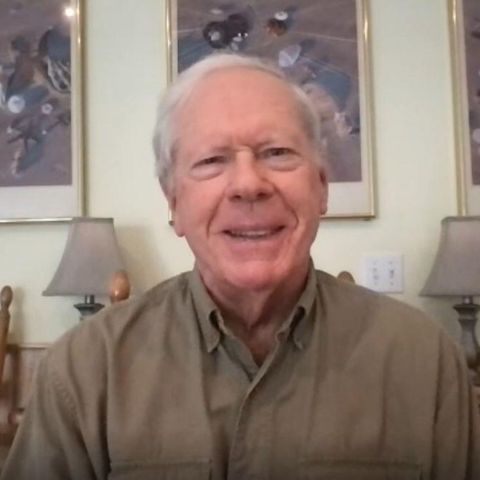
Paul Craig Roberts
Paul Craig Roberts is an economist who served as Assistant Secretary of the Treasury for Economic Policy in the Reagan administration and was an associate editor of the Wall Street Journal and a columnist for Business Week before becoming a long-running critic of American foreign policy. He appears on Glenn Diesen's program and Dialogue Works. He is the roster's sharpest internal dissenter on Russia: where most of the voices here read Russian restraint as strength, he reads it as the strategic error that let the war widen.
Where they stand
A short read of where Paul Craig Roberts lands on each front we follow, drawn from their recent appearances and refreshed whenever they turn up in a debrief.
Iran
Iran cannot be defeated militarily or economically, and the US and Israeli campaign against it is failing, with the costs falling on the United States and Iran rather than Israel. But he warns Iran is repeating what he considers Putin's error, fighting a tit-for-tat war with the proxy while ignoring the real antagonist, and argues time favours the Israel and Trump side the longer that standoff drags on. Now says the shifting official Hormuz oil-flow figures are incoherent, argues there is no real US-Iran conflict on the merits because Iran never attacked the United States and remains in compliance with its non-proliferation commitments, and suspects Saudi Arabia acted as a proxy in asking Iran and Oman to shelve the announcement of their new Hormuz transit mechanism.
as of 2026-09-14
Ukraine & Russia
The roster's dissenting read: Putin's tit-for-tat approach has been a strategic failure, not restraint rewarded. By declining to use sufficient force he let the war widen from the Donbas to strikes deep inside Russia, NATO has grown rather than fractured since it began, member states are individually preparing for war with Russia, and NATO now accepts American nuclear weapons on Russia's border. Expects that at some point Putin or a successor will have no alternative left but to use the heavy weapons. Pushes back on the claim that the Black Sea blockade has crippled Ukraine outright, noting the land links remain open, while granting that Ukrainian drone strikes have forced real gasoline rationing in Russia. Now says Trump cannot end the war because the military and security complex needs a Russian enemy to justify its budget, and expects the war to keep widening and possibly merge with the Middle East conflict.
as of 2026-09-14
Israel
Holds that the Greater Israel expansion agenda is the actual driver of the conflict and remains costless to Israelis because Americans take the casualties, with no internal Israeli constraint currently checking Netanyahu. At the same time he judges the expansion project now implausible, blocked by a bloc of roughly 450 million people holding nuclear weapons, oil and the strategic waterways, and he dismisses the new Sunni, Turkish, Pakistani and Saudi defence alliance as an illusion rather than a real bloc, since each member joined for its own separate reasons. Now says the new Saudi, Turkey and Pakistan defence pact has no teeth because it excludes Iran, Lebanon and Yemen and treats fellow Muslim states as the threat, leaving Israel to benefit while Arab states fight each other.
as of 2026-09-14
American power
Reads Foreign Affairs, Council on Foreign Relations and Atlantic Council pieces conceding that the days of American hegemony are over as the significant development: the neoconservative and Wolfowitz-doctrine grip on US foreign policy, unbroken since the Bush era, is cracking after the failure to subdue Iran. Holds that the entrenched military-security complex Eisenhower warned of constrains any president from changing course, leaving Trump increasingly out of control of his own policy. Now calls Congress a creature of the Israel lobby and argues no independent US Middle East policy is possible while the alliance holds, dismissing Chinese and Russian offers to mediate as missing that Washington cannot make a deal with Iran without Israel's consent.
as of 2026-09-14
The global economy
Freezing and confiscating the central bank reserves of Russia, Venezuela and Iran is eroding foreign willingness to hold US Treasury debt as reserves, which he treats as a larger threat to the dollar than petrodollar diversification. Separately notes that Ukrainian strikes on Russian refineries and depots have caused genuine gasoline rationing and forced Russia to import diesel, so the economic war on Russian energy is real rather than a battlefield story.
as of 2026-09-08
Recent appearances
Xi and Putin cannot save Trump in Hormuz
Dialogue Works · 2026-09-14