
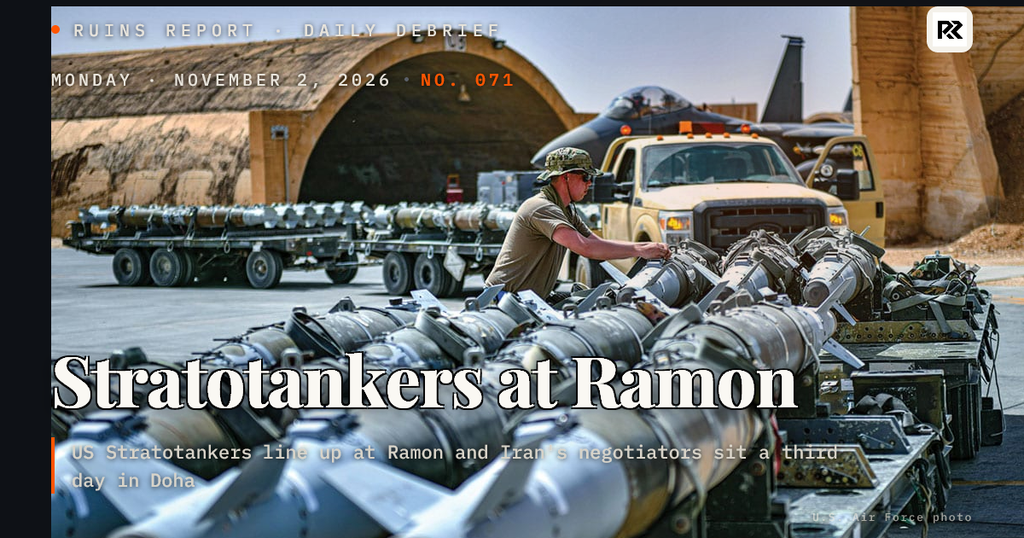
Israeli media published photographs on Sunday 1 November of at least 13 US air refueling tankers lined up at Ramon air base in the Negev,¹ and Reuters reported an Iranian delegation in Qatar for a third consecutive day of talks.² Tuesday's midterm vote falls between the two. Axios reported that Benjamin Netanyahu is pressing Trump to attack Iran immediately after the midterms, while Trump prefers the Qatar-mediated negotiations.³ I24 News reported that the two men spoke on Saturday under such secrecy that Netanyahu's closest advisers were kept out of the call.⁴ Trump's own version of the choice was shorter. The United States has had its victory, he said, and will put it away soon, one way or the other. Iran "will either make a deal, or we will end it."
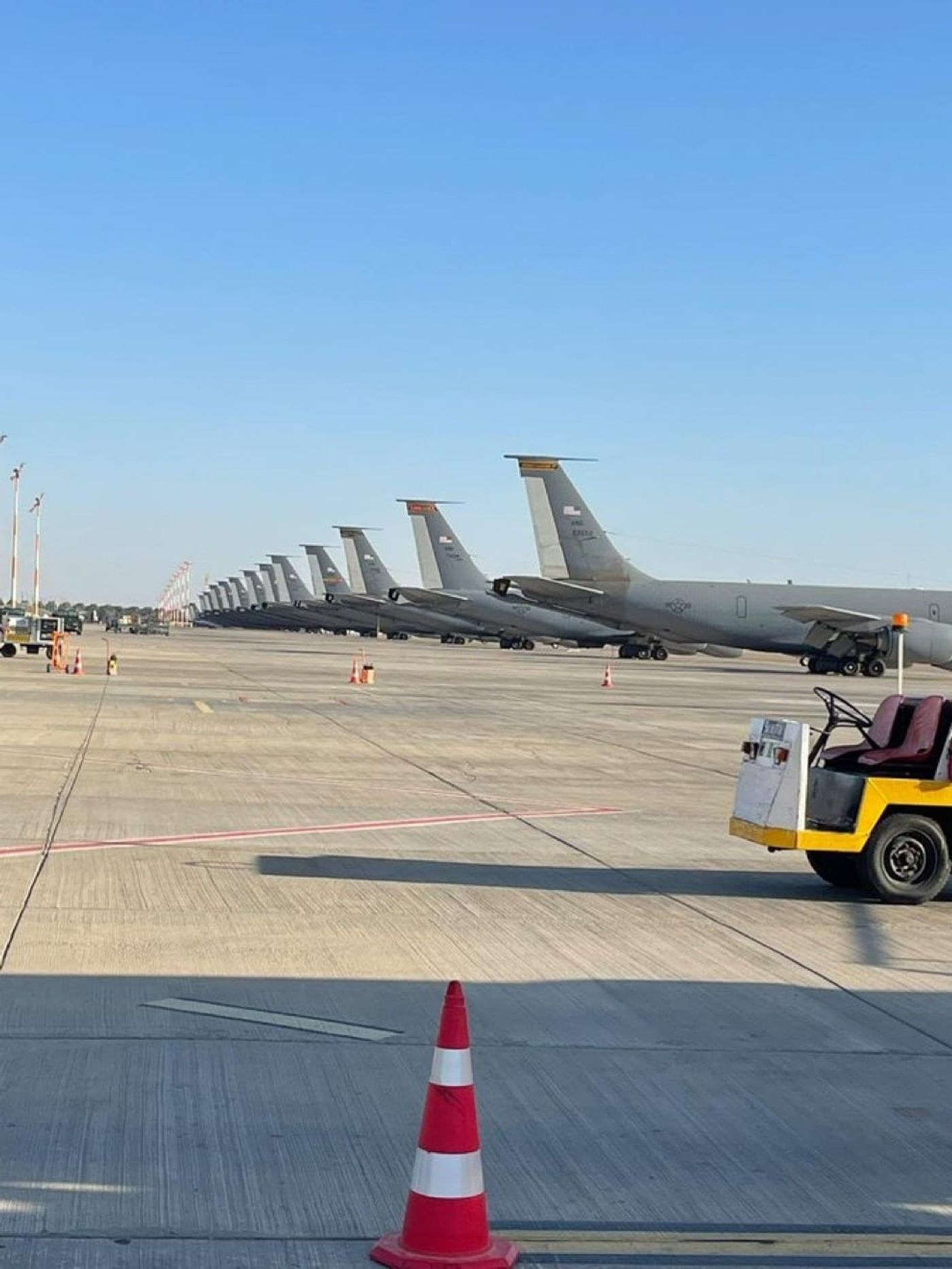
The Stratotankers follow Friday's airlift into Israel. The strike they are there for was expected by every analyst in yesterday's issue, written after Saturday's order from Tehran. On Sunday one analyst doubted that it comes. On a second question, whether a third round can be won, there is no doubt at all. Nobody quoted today thinks it can.
Larry Johnson thinks an American attack on Iran after the midterms is highly likely,⁵ and that nothing will happen before Tuesday afternoon.⁶ Shaiel Ben-Ephraim, a former Unit 8200 officer, was asked whether the war resumes after the vote. "100%. Not even a question," he said.⁷ What he added was missing from yesterday's accounts. Washington is talking about a short, sharp shock, while Israel is already discussing regime change in the next round.⁸ Trita Parsi heard the same ambition on Israeli television, where the defense ministry has said the next round will set Iran back to the stone age, or at least 40 years.⁹ Ben-Ephraim expects Netanyahu, now a caretaker without a majority, to drag the war out and widen it to strengthen his hand in coalition talks.¹⁰ Parsi's point was that the Israeli push does not depend on Netanyahu. The Israelis will keep pressing for war while Trump is in office, whoever is prime minister. After the June war Parsi argued that Israel wants a neighborhood in which no country can deter it, and the second round bore that out.¹¹
Andrew Day of The American Conservative, who writes its daily Iran war diary, has read the same signals and does not believe them. He is skeptical of the reports of imminent strikes, though he allowed that he might feel differently in a month.¹² His reason is the record of the ceasefire. Iran has shown what damage it can do, he said, and has kept a large retaliatory capability; October was the worst month for strikes in the Strait of Hormuz since the war began.¹³ His conclusion is short. "I think that basically deterrence works."¹⁴ That preference for pressure over bombing has a voice inside the administration. John Mearsheimer said Scott Bessent favors economic strangulation and the naval blockade over more strikes.¹⁵ Day's skepticism has a limit, and he named it. Israel's election left Netanyahu without a majority and the opposition without one either. For anyone opposed to the Iran war, Day said, that is the worst case,¹⁶ because it leaves a wounded caretaker with every reason to provoke a crisis. An attack right after the midterms, he said, could be the point of no return.¹⁷



On whether a third round can be won, there is no disagreement. Mearsheimer put the military case in one sentence. "A three-day bombing campaign is not going to accomplish what a 40-day bombing campaign did not accomplish at the beginning of this conflict."¹⁸ Iran, in his account, has learned over the course of the war that it holds far more leverage than it first realized,¹⁹ and if escalation produces a real war, he thinks Iran wins it.²⁰ Johnson expects the strike and expects the same result. Iran has lifted the limits it had put on its anti-ship missiles,²¹ and the plan to seize islands in the strait runs into a problem of numbers. Qeshm is about the size of Okinawa, which the United States took in 1945 with 180,000 soldiers and marines, and nothing near that force is available now.²² Parsi described what Washington is asking for in Doha. "I don't think Trump is necessarily looking for concessions as much as he's looking for capitulation. And I don't see capitulation in the cards at all."²³ A third round, he said, would be lose-lose-lose. What Trump needs from it, in Johnson's summary, is to save the election, defeat Iran and declare victory in January. He called that impossible.²⁴
So the difference on Sunday is a narrow one. Day doubts the strike comes, because deterrence holds. Johnson and Ben-Ephraim are certain it comes and doubt it works. Nobody argues that a third round can be won, including the two who are surest it will be fought. What separates them is whether Washington knows this. Johnson thinks the president may not. "He lies to himself and his aides lie to him. So yeah, he may actually believe that we've got the upper hand and that Iran is weak."²⁵

“There is no American security umbrella in the region any longer.”
Nobody thinks a third round can be won because the first two already destroyed the American security position in the Gulf. Parsi's conclusion is that the American security umbrella over the region no longer exists, and that the Gulf states are pretending it still does.²⁶ Mearsheimer's version is physical. American bases in the Gulf are highly vulnerable, he said, and any troops or aircraft on them are liable to be destroyed,²⁷ which is why he thinks the Gulf states should reach a modus vivendi with Iran. Johnson called it the collapse of American influence in the Persian Gulf, something nobody expected.²⁸ Washington keeps going back to a war it cannot win, and Day's explanation is pressure from Israel. Israel, he said, is good at narrowing the foreign policy options of American presidents.²⁹ Parsi doubts the test will be repeated after this one. "I find it very unlikely that any future American president will think about a war with Iran again."³⁰ That leaves the present one. His Stratotankers sit at Ramon, ready for a campaign that none of the people who expect it believe can succeed. In Doha, an Iranian delegation is in its third day of hearing terms that Parsi reads as a demand for surrender.
Twenty bodies for one in Ukraine, and a mine no ship has hit
Daniel Davis described Operation Vivaldi, a Ukrainian offensive near Lyman now four or five months old, as the only place on the line where Ukraine has advanced, and he does not expect the gain to hold. "This is a war of attrition not headlines," he said.³¹ His measure of the attrition is the body exchanges, which return 20 and sometimes 30 Ukrainian dead for every Russian.³² Chay Bowes, a Moscow-based Irish journalist, relayed a figure from Donald Tusk, who told a press briefing, citing Ukrainians, that about 27,000 Ukrainians are killed a month. Zelensky claims fewer than 55,000 dead in the whole war.³³ The average Ukrainian infantryman, Bowes said, is now just under 50 years old.³⁴
Sal Mercogliano went through the footage of tankers burning in the Strait of Hormuz and found no mine in it. "There is zero zero indication that any ship has hit a mine," he said.³⁵ Iran has shifted to limpet mines, fixed by hand from a small boat, which means getting alongside a ship under way; difficult, he said, but not impossible.³⁶ About 5 percent of transiting vessels are being hit.³⁷ Lloyd's List counts more than 570 vessels attacked in the Black Sea since the start of 2026 and at least 40 seafarers killed, against about 26 in Hormuz and the Gulf.³⁸
Sources
- Israeli media, as read on Dialogue Works · Photographs of at least 13 US air refueling tankers lined up at Ramon air base in Israel, published 1 November · watch ▶
- Reuters, as read on Dialogue Works · An Iranian delegation is in Qatar for a third consecutive day of talks · watch ▶
- Axios, as read on Dialogue Works · Netanyahu is pressing Trump to attack Iran immediately after the midterms while Trump prefers the Qatar-mediated negotiations, per Barak Ravid · watch ▶
- I24 News, as read on Dialogue Works · The Saturday Netanyahu-Trump call was held under unusually strict secrecy, with Netanyahu's closest advisers excluded · watch ▶
- Larry Johnson, Dialogue Works · "I think it's highly likely that Trump will launch an attack on Iran after the midterms" · watch ▶ 3:58
- Larry Johnson, Dialogue Works · "I don't think anything will happen between now and Tuesday afternoon" · watch ▶ 33:17
- Shaiel Ben-Ephraim, Mario Nawfal · Asked whether the US and Israel go back to war with Iran after the midterms: "100%. Not even a question" · watch ▶ 29:51
- Shaiel Ben-Ephraim, Mario Nawfal · "The US is talking about some kind of short sharp shock and Israel is already talking about regime change in the next round" · watch ▶ 29:56
- Israeli defense ministry, as read on Tom Switzer · Said on Israeli television that the next round will set Iran back to the stone age, or at least 40 years, per Trita Parsi · watch ▶
- Shaiel Ben-Ephraim, Mario Nawfal · Netanyahu "is going to drag this out and expand it as much as possible in order to affect the negotiations over the coalition," and will get the government he wants or another election fought on security · watch ▶ 30:04
- Trita Parsi, Tom Switzer · The Israelis will keep pushing for war on Iran while Trump is in office, whoever is prime minister; recalling his argument after the June war, borne out by the second round, that Israel "want[s] to live in a neighborhood in which no one will be able to have any type of deterrence against Israel" · watch ▶ 12:24
- Andrew Day, Scott Horton Show · "All of these reports and analyses that are saying there's going to be imminent strikes, I'm personally kind of skeptical"; he may feel differently in a month · watch ▶ 7:48
- Andrew Day, Scott Horton Show · "Iran has demonstrated what kind of damage it can do and it clearly has retained significant retaliatory capabilities when you consider that October was the worst month for strikes in the Strait of Hormuz since the war began" · watch ▶ 6:32
- Andrew Day, Scott Horton Show · "I think that basically deterrence works" · watch ▶ 7:27
- John Mearsheimer, Tom Switzer · Treasury Secretary Scott Bessent favors economic strangulation and the naval blockade over more strikes · watch ▶
- Andrew Day, Scott Horton Show · "It is the worst case for the US, if you're opposed to the Iran war, for this situation to have occurred, which is basically that Netanyahu's coalition lost its governing majority, but the opposition block did not win a governing majority" · watch ▶ 2:30
- Andrew Day, Scott Horton Show · An attack right after the midterms "might be the point of no return" · watch ▶ 25:20
- John Mearsheimer, Tom Switzer · "A three-day bombing campaign is not going to accomplish what a 40-day bombing campaign did not accomplish at the beginning of this conflict" · watch ▶ 0:50
- John Mearsheimer, Tom Switzer · "The Iranians have figured out more and more as time goes by that they have much more leverage than they realized at the beginning of this war" · watch ▶ 5:44
- John Mearsheimer, Tom Switzer · "If this plays itself out in terms of real escalation you get a real war I think the Iranians win" · watch ▶ 4:41
- Larry Johnson, Dialogue Works · "The Iranians have taken the caps off of these missiles, the limitations. So they now have some of the missiles with unlimited anti-ship capabilities" · watch ▶ 6:19
- Larry Johnson, Dialogue Works · Qeshm "is about the size of Okinawa," which the US attacked in World War II "with 180,000 soldiers and marines. We don't have anything near that amount" · watch ▶ 19:55
- Trita Parsi, Tom Switzer · "I don't think Trump is necessarily looking for concessions as much as he's looking for capitulation. And I don't see capitulation in the cards at all"; a third round would be lose-lose-lose · watch ▶ 2:21
- Larry Johnson, Dialogue Works · "It would be utterly in the realm of impossible for him to save the election and to defeat Iran and to be in a comfortable position where he gets to declare victory come January. Not going to happen" · watch ▶ 18:49
- Larry Johnson, Dialogue Works · "He lies to himself and his aides lie to him. So yeah, he may actually believe that we've got the upper hand and that Iran is weak" · watch ▶ 4:53
- Trita Parsi, Tom Switzer · "There is no American security umbrella in the region any longer"; the Gulf states are pretending it still works · watch ▶ 35:01
- John Mearsheimer, Tom Switzer · "American military installations in the Persian Gulf region are highly vulnerable and any troops or aircraft that are in those bases are liable to get destroyed"; the Gulf states should work out a modus vivendi with Iran · watch ▶ 31:26
- Larry Johnson, Dialogue Works · "The collapse of US influence in the Persian Gulf. Something that nobody expected or anticipated" · watch ▶ 40:31
- Andrew Day, Scott Horton Show · "Israel is good at kind of reducing the foreign policy and diplomatic options of US presidents" · watch ▶ 11:39
- Trita Parsi, Tom Switzer · "I find it very unlikely that any future American president will think about a war with Iran again" · watch ▶ 11:31
- Daniel Davis, Scott Horton Show · Operation Vivaldi in the Lyman area is the only place on the line where Ukraine has advanced and will not be sustained; "This is a war of attrition not headlines" · watch ▶ 7:36
- Daniel Davis, Scott Horton Show · "Every time we have these troop exchanges you have between 20 and in a few cases 30 to one Ukraine bodies going back in exchange for Russian bodies" · watch ▶ 14:02
- Chay Bowes, Redacted · Donald Tusk told a press briefing, citing Ukrainians, that about 27,000 Ukrainians are killed a month; Zelensky claims fewer than 55,000 dead in total · watch ▶
- Chay Bowes, Redacted · "The average age of an infantry combat man in the Ukrainian military now is around just under 50 years of age" · watch ▶ 44:03
- Sal Mercogliano, What's Going on With Shipping? · "There is zero zero indication that any ship has hit a mine" · watch ▶ 17:12
- Sal Mercogliano, What's Going on With Shipping? · On limpet mines: "You have to get physically alongside. It is very difficult to do that when the ship's underway. Not impossible, but you can do it" · watch ▶ 20:01
- Sal Mercogliano, What's Going on With Shipping? · "We are estimating that the amount of ships getting hit is about 5%" · watch ▶ 22:15
- Lloyd's List, as read on What's Going on With Shipping? · The Black Sea has overtaken the Persian Gulf as the deadliest shipping route: over 570 vessels attacked since the start of 2026 with at least 40 seafarers killed, against about 26 in Hormuz and the Gulf · watch ▶
By Ruins Report, a daily synthesis of what our tracked analysts said, not original reporting. Every numbered claim is sourced, dated, and timestamped above.
Newsletter
Get the Daily Debrief
One email each morning: what the analysts we track actually said, and every call timestamped to its source. Free.
Free. No spam. View on Substack →
Support the Report
Free to read, every day.
The Debrief is compiled each morning from what the analysts we track actually said, sourced and timestamped. No paywall, no ads, no investors. If it earns a place in your inbox, you can help keep it independent.
Support the report →