
Singapore's maritime authority has confirmed that the GFS Pride, a container ship carrying about 2,500 boxes, sank after a fire that followed an attack on Tuesday 13 October; all 21 of her crew are safe.¹ A second Singapore-registered container ship, the GFS Gazelle, was struck on Wednesday 14 October, took hull damage and reached anchorage under her own power with her 22 crew unharmed.² Sal Mercogliano drew the line plainly: "the loss of GFS Pride marks the first sinking of a vessel since the beginning of the war."³ Daniel Davis opened his Wednesday programme with another: a UAE-owned container ship, its transponder switched off for about ten days, hit and likely sinking.⁴
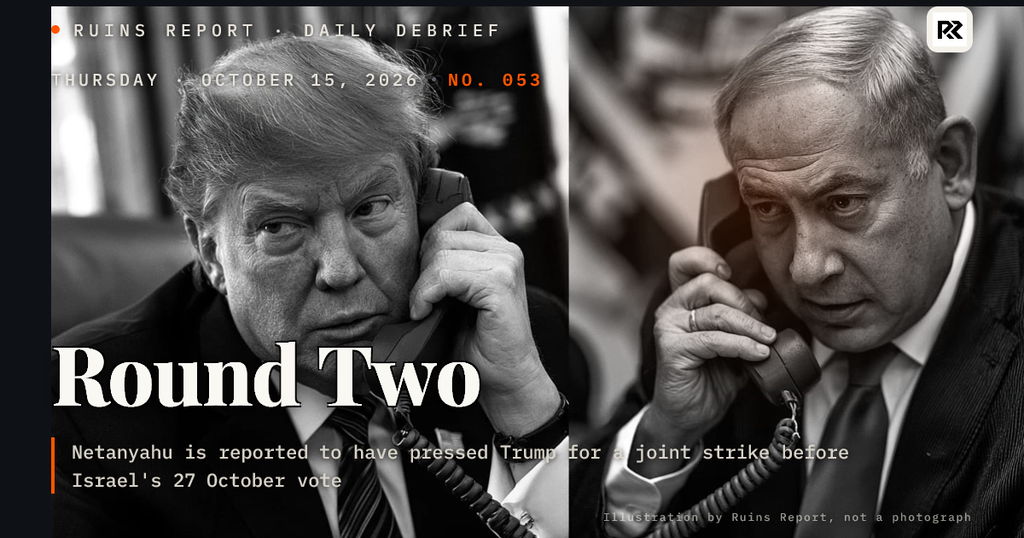
The attacks on the two ships came in the same day as a report of what passed between Netanyahu and Trump. On Wednesday's Mario Nawfal broadcast it was put that it had been "reported in the last 24 hours that Netanyahu on the phone call last Wednesday with Trump brought it up and Trump said yeah if you want to go ahead get ready to do it."⁵ Israel votes on Tuesday 27 October. Trump has said in public that he will not attack Iran before the 3 November midterms. Between those two dates sits the question of whether the second round of the war has already started, and who fires first.
Anthony Aguilar does not believe the pledge. Trump has repeated that he will not strike before the midterms; Aguilar's answer was "You're going to strike before the midterms," and then "Me thinks that he doth protest too much."⁶ "We're no longer in the realm of ifs and cans. It's will we?"⁷ His forecast is specific: "in the next, you know, 13 days before the 27th of October, we're going to see Netanyahu act and we're going to see the United States participate directly."⁸ The carrier Roosevelt, he noted, is still en route and not yet in theatre.⁹
Laith Marouf puts the odds at nine in ten. He pointed to Reuters, which, citing Iranian officials, has Iran "deploying new tactics to target ships sailing through the" Strait, with the stated aim of keeping oil prices high and weighing on the American midterms.¹⁰ "I think in the next few weeks we will be back in full war situation,"¹¹ he said, and of a major new US-Israeli attack before the Israeli and American elections: "I think there's 90% chance that this is going to happen."¹² In his reading Iran would win a renewed war, and the Gulf monarchies are the ones exposed.
Alastair Crooke expects Tehran not to wait. Iran says it has mobilized 420,000 troops in recent weeks and has warned Washington and Israel of possible ground incursions into neighbouring countries.¹³ Crooke: "we are heading towards a big escalation in the region which will affect much of the region if not pretty well all of the region."¹⁴ On the attack being lined up against Iran: "they will either preempt it or they will attack first, I believe."¹⁵ What has changed at sea, he argues, is the aim point. "What is different this time is that Iran is aiming for the engine room."¹⁶ "Now they are attacking the engine rooms. And this changes things in a very great way,"¹⁷ because a ship hit there is "not going to be repaired."¹⁸ The purpose is leverage: "Iran is tightening the screws on Trump basically, and they're tightening the screws on the passage of oil."¹⁹
The counter-view came from Mark Montgomery, a retired rear admiral, who reads the same attacks as the thrashing of a country being strangled. "What we're trying to do here is cut off $15 billion a month worth of fossil fuel sales,"²⁰ he said of the blockade, and "if we're blocking 95 to 98% of it, we're doing fine."²¹ By his count the Navy has taken "at least 800 weapons, maybe more fired at our US Navy ships, and they have engaged all, none have hit."²² "This is a losing economic case for the Iranians who are no longer pumping oil."²³ Iran lashes out, in his telling, because the blockade is working.
Mercogliano's figures sit awkwardly with both readings. CENTCOM announced that US forces had moved more than 19 million barrels of crude through Hormuz in a single day; his reply was that "Maybe one day you get 19 million barrels out, but the average is probably right around 11 to 12 million barrels per day."²⁴ The LR2 tanker index from the Persian Gulf to Europe stands at $300,000 a day.²⁵ And on the claim that stands behind the whole blockade: "you can't really say that you control the Strait of Hormuz when we have these rash of attacks."²⁶ His own name for the waterway: "Strait of Hormuz is becoming Iron Bottom Strait."²⁷

Put the accounts together and the premise of the question dissolves. The second round is not waiting on a decision in Jerusalem or Washington. It is being fought now, at sea, by a side that has moved its aim point from the superstructure to the engine room and its objective from closing the Strait to keeping the price of what passes through it high until American voters go to the polls. What Netanyahu is reported to want, and what Trump is reported to have assented to, is the air phase of a war whose naval phase never paused. Who moves first is really a question of which calendar governs: Israel's on 27 October or America's on 3 November.
The deeper problem is that none of the three readings offers an end state. Montgomery's blockade is a pressure instrument, not a victory; it works only for as long as Washington can absorb the price of oil, and Crooke's point is that the price is the weapon pointed back. "The main weapon that Iran and Ansarallah have is already apparent. It's in the inflation we're all feeling,"²⁸ with diesel rationing likely in Europe.²⁹ Aguilar's next escalation "will involve Yemen. It will involve Saudi Arabia" and the Gulf, not an exchange confined to Iran and the United States.³⁰ Mercogliano, whose subject is shipping rather than strategy, said it most plainly: "There's going to be no surrender on the deck of the battleship Missouri that ends this conflict."³¹ There is no military fix, only a political and economic compromise, and nothing in Wednesday's episodes suggested that anyone in Washington or Jerusalem is looking for one.

“There's going to be no surrender on the deck of the battleship Missouri that ends this conflict.”
All of Kiev goes dark, and the arithmetic over Riyadh
One of Russia's heaviest missile strikes of the war on Kiev, in which the Defence Ministry named the Darnitskaya, Kievskaya and Tripolskaya power stations, left the whole city without power and stopped the metro. Alexander Mercouris set it against the outages of the past week, when Kiev's west bank went dark: "Previous power blackouts in Kiev have been extensive but localized. This time the entire city is dark, pointing to a catastrophic failure in the electricity system."³² His conclusion was stark: "the Ukrainian authorities have no alternative but to order an evacuation of the civilian population from Kiev."³³
Asked whether Washington can defend Saudi Arabia from Houthi missiles and drones, John Mearsheimer said that "the United States simply doesn't have the capability because the United States and the Saudis are on the defense."³⁴ The reason is arithmetic rather than will: "the offensive missiles can overwhelm the defensive missiles."³⁵
Sources
- Sal Mercogliano, What's Going on With Shipping? · Singapore's maritime authority confirmed GFS Pride, about 2,500 boxes, sank after a fire following an attack on 13 October; all 21 crew safe · watch ▶ 1:37
- Sal Mercogliano, What's Going on With Shipping? · GFS Gazelle struck on 14 October, hull damage, reached anchorage under her own power, 22 crew safe · watch ▶ 1:48
- Sal Mercogliano, What's Going on With Shipping? · "the loss of GFS Pride marks the first sinking of a vessel since the beginning of the war" · watch ▶ 7:58
- Daniel Davis, Daniel Davis / Deep Dive · A UAE-owned container ship, AIS off for about ten days, hit and likely sinking · watch ▶ 0:39
- Report raised on air, Mario Nawfal (hosted by Brandon Weichert) · "reported in the last 24 hours that Netanyahu on the phone call last Wednesday with Trump brought it up and Trump said yeah if you want to go ahead get ready to do it" · watch ▶ 16:03
- Anthony Aguilar, Mario Nawfal · On Trump's pledge not to strike before the midterms: "You're going to strike before the midterms." "Me thinks that he doth protest too much." · watch ▶ 15:39
- Anthony Aguilar, Mario Nawfal · "We're no longer in the realm of ifs and cans. It's will we?" · watch ▶ 15:24
- Anthony Aguilar, Mario Nawfal · "in the next, you know, 13 days before the 27th of October, we're going to see Netanyahu act and we're going to see the United States participate directly" · watch ▶ 17:57
- Anthony Aguilar, Mario Nawfal · The carrier Roosevelt is still en route and not yet in theatre · watch ▶ 2:33
- Laith Marouf, Rachel Blevins · Reuters, citing Iranian officials, has Iran "deploying new tactics to target ships sailing through the" Strait to keep oil high and weigh on the US midterms · watch ▶ 21:07
- Laith Marouf, Rachel Blevins · "I think in the next few weeks we will be back in full war situation." · watch ▶ 28:46
- Laith Marouf, Rachel Blevins · On a major new US-Israeli attack before the elections: "I think there's 90% chance that this is going to happen." · watch ▶ 29:56
- Danny Haiphong, Danny Haiphong · Iran says it has mobilized 420,000 troops in recent weeks and warns the US and Israel of possible ground incursions into neighbouring countries · watch ▶ 0:17
- Alastair Crooke, Danny Haiphong · "we are heading towards a big escalation in the region which will affect much of the region if not pretty well all of the region" · watch ▶ 2:41
- Alastair Crooke, Danny Haiphong · On the US-Israeli attack being lined up: "they will either preempt it or they will attack first, I believe." · watch ▶ 12:47
- Alastair Crooke, Danny Haiphong · "what is different this time is that Iran is aiming for the engine room" · watch ▶ 14:23
- Alastair Crooke, Danny Haiphong · "Now they are attacking the engine rooms. And this changes things in a very great way" · watch ▶ 14:37
- Alastair Crooke, Danny Haiphong · Vessels hit in the engine room "are not going to be repaired" · watch ▶ 14:46
- Alastair Crooke, Danny Haiphong · "Iran is tightening the screws on Trump basically, and they're tightening the screws on the passage of oil." · watch ▶ 37:52
- Mark Montgomery, Daniel Davis / Deep Dive · "What we're trying to do here is cut off $15 billion a month worth of fossil fuel sales" · watch ▶ 10:14
- Mark Montgomery, Daniel Davis / Deep Dive · "if we're blocking 95 to 98% of it, we're doing fine" · watch ▶ 10:34
- Mark Montgomery, Daniel Davis / Deep Dive · "I think we've had at least 800 weapons, maybe more fired at our US Navy ships, and they have engaged all, none have hit" · watch ▶ 12:30
- Mark Montgomery, Daniel Davis / Deep Dive · "this is a losing economic case for the Iranians who are no longer pumping oil" · watch ▶ 2:33
- Sal Mercogliano, What's Going on With Shipping? · On CENTCOM's 19 million barrels in a day: "Maybe one day you get 19 million barrels out, but the average is probably right around 11 to 12 million barrels per day." · watch ▶ 13:00
- Sal Mercogliano, What's Going on With Shipping? · The LR2 tanker index, Persian Gulf to Europe, is at $300,000 per day · watch ▶ 9:44
- Sal Mercogliano, What's Going on With Shipping? · "you can't really say that you control the Strait of Hormuz when we have these rash of attacks." · watch ▶ 9:06
- Sal Mercogliano, What's Going on With Shipping? · "Strait of Hormuz is becoming Iron Bottom Strait." · watch ▶ 0:20
- Alastair Crooke, Danny Haiphong · "the main weapon that Iran and Ansarallah have is already apparent. It's in the inflation we're all feeling" · watch ▶ 45:32
- Alastair Crooke, Danny Haiphong · Diesel rationing likely in Europe · watch ▶ 45:39
- Anthony Aguilar, Mario Nawfal · The next escalation "will involve Yemen. It will involve Saudi Arabia" and the Gulf, not just exchanges between Iran and the US · watch ▶ 7:01
- Sal Mercogliano, What's Going on With Shipping? · "There's going to be no surrender on the deck of the battleship Missouri that ends this conflict." · watch ▶ 14:16
- Alexander Mercouris, Alexander Mercouris · "Previous power blackouts in Kiev have been extensive but localized. This time the entire city is dark, pointing to a catastrophic failure in the electricity system." · watch ▶ 36:35
- Alexander Mercouris, Alexander Mercouris · "the Ukrainian authorities have no alternative but to order an evacuation of the civilian population from Kiev" · watch ▶ 42:16
- John Mearsheimer, John Mearsheimer · On defending Saudi Arabia from Houthi missiles and drones: "the United States simply doesn't have the capability because the United States and the Saudis are on the defense." · watch ▶ 9:12
- John Mearsheimer, John Mearsheimer · "the offensive missiles can overwhelm the defensive missiles" · watch ▶ 6:41
By Ruins Report, a daily synthesis of what our tracked analysts said, not original reporting. Every numbered claim is sourced, dated, and timestamped above.
Newsletter
Get the Daily Debrief
One email each morning: what the analysts we track actually said, and every call timestamped to its source. Free.
Free. No spam. View on Substack →
Support the Report
Free to read, every day.
The Debrief is compiled each morning from what the analysts we track actually said, sourced and timestamped. No paywall, no ads, no investors. If it earns a place in your inbox, you can help keep it independent.
Support the report →