
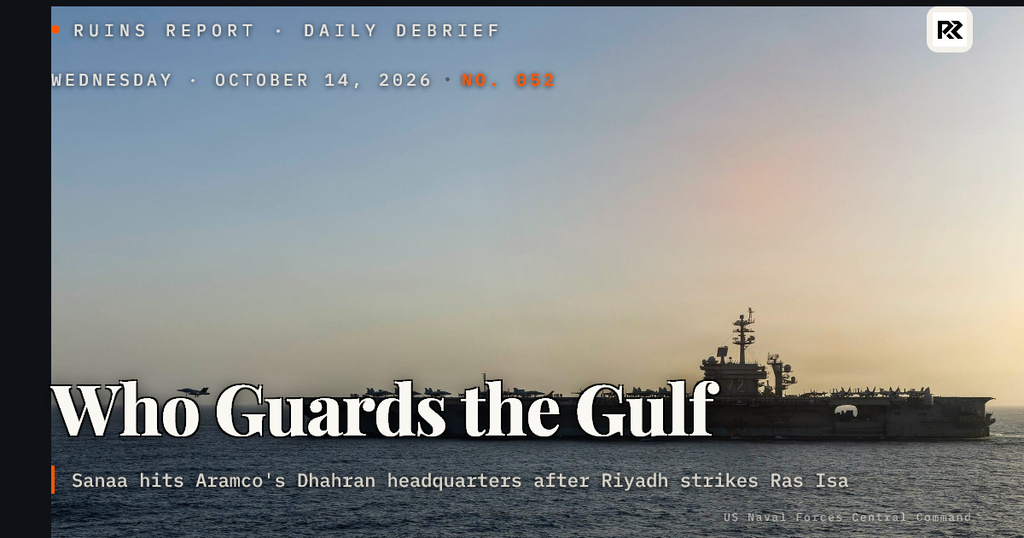
Saudi aircraft struck Ras Isa, the main oil port in Yemen, on Tuesday 13 October, after the government in Sanaa had warned Riyadh not to touch it. Sanaa answered by naming three targets of its own: the headquarters of Saudi Aramco in Dhahran, the international airport, and a refinery in Riyadh. Within hours Reuters was reporting the Dhahran headquarters hit and a video of the impact was circulating, as the host of Mario Nawfal's show relayed on air to his guest, Ian Bremmer.¹ The Saudi-led coalition's own statement, read on the same broadcast, said air defences had intercepted three cruise missiles and two drones in the Riyadh area in the preceding hour, which left the host asking how so small a salvo could still reach the headquarters of the kingdom's most important company.² Bremmer called it the biggest critical-infrastructure news in the Gulf since the opening months of the war, "and it's not the Iranians that did it."³
The kingdom went into the day with its main airport shut until 17 October and the strike that killed 13 at King Khalid still unanswered. What is new is that the answer, when it came, came from Riyadh alone. Douglas Macgregor was asked whether Donald Trump, with American forces poised for a renewed war on Iran, could divert some of them against the Houthis. He allowed that the president probably could, "I just don't see that he's going to do that." His reading is that Trump has concluded Saudi Arabia may not be rescuable, "that there may be nothing we can do to rescue the state of Saudi Arabia from dissolution," and that at some point Washington tells Riyadh it has no more to give.⁴
Chas Freeman, who served as ambassador in Riyadh, drew the conclusion that follows. The failure to come to Saudi Arabia's aid is the latest in a long chain of such failures, he said, and "it marks the collapse of American prestige and influence in the entire Persian Gulf region in a very dramatic way."⁵ He does not think the restraint is an accident. Trump, asked on Monday 12 October whether the attack on Saudi Arabia had changed his pledge not to strike Iran before the midterms, said only that "we're going to take a look," and Freeman believes the people around him understand what intervention would cost: the blockade of the Bab el-Mandeb that Ansar Allah now directs only at Saudi vessels "will be extended to American vessels," returning the strait to the total closure of five years ago. A Chinese container ship was hit there this week even though it advertised no connection to Saudi Arabia.⁶
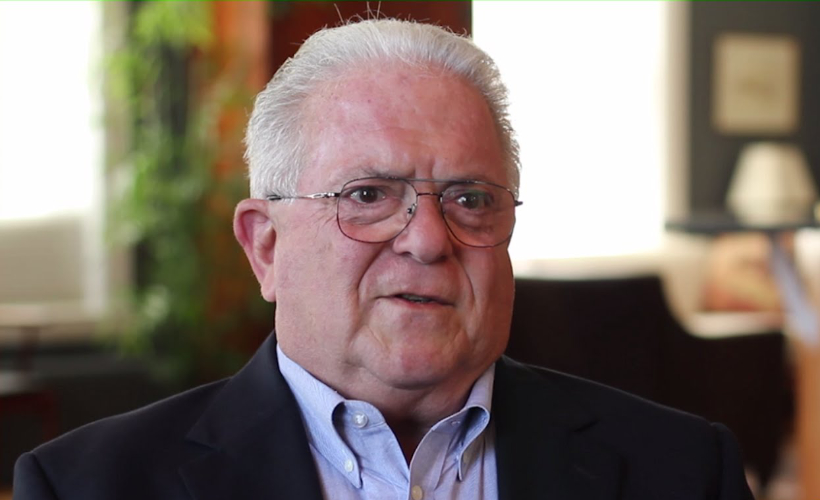
“The failure to come to the aid of Saudi Arabia is the latest in a long chain of such failures. And it completely discredits the United States as the protector of Saudi Arabia, which is our traditional role.”
Trita Parsi states the same judgment as a forecast. "I see no scenario in which the United States goes back to the role that it played before February 28th of this year," he said.⁷ Because "the US is no longer the security guarantor of the region," he expects Chinese economic influence to grow into the space the guarantee leaves behind.⁸ The states that still host American forces inherit the risk without the protection: if Washington strikes Iran again from Kuwaiti and Bahraini territory, "you will likely see attacks against Kuwait and Bahrain," because neither has the agency to tell the United States no.⁹
The American guarantee in the Gulf, on this reading, was not withdrawn. It was called, in public, and did not answer.
What fills the space is already under construction. Bremmer sees in Pakistan's collective security pact with the kingdom "the beginnings of the creation of a Muslim NATO," anchored on Riyadh and in a sense funded by it, with Saudi cheques to Islamabad as the binding agent, and he poses the question the pact only begins to answer: "if the United States is no longer going to play a core role in providing security guarantees across the Middle East, what does a new Middle East security architecture look like?" Saudi Arabia, he said, is having those conversations in a very serious way right now.¹⁰
The first thing the new arrangement must do is let Riyadh refuse a settlement. Bremmer finds it impossible to imagine the Saudis seeking a deal, because it "would show way too much weakness" when the main international airport is shut and the headquarters of the most important company is taking a direct hit; the kingdom now has to show it can take land back and stop the strikes, and that has become "a matter of legitimacy and security for Mohammed bin Salman."¹¹
The cost of holding that line is where the analysts we track converge most closely. Freeman puts reconstruction at "probably a couple of trillion dollars" over five to seven years, with Vision 2030 set aside to pay for it,¹² and he expects the energy prices of the Iran war to be "locked in and increased," because Saudi Arabia "will no longer be the buffer for the world, the supplier of last resort."¹³ Alexander Mercouris arrives at the same buffer from the market side. The kingdom's ability to keep exporting through the Red Sea is what prevented oil "from surging all the way up to $150 a barrel and beyond," and Houthi strikes on installations that take months to repair would prolong the energy crisis whatever happens with Iran.¹⁴ A Saudi crisis, on his reading, is now a larger problem for Trump than Ukraine, and Zelensky has become one of the president's lesser ones.¹⁵
Why Washington would let this happen to a state it has traditionally protected is the deeper question, and Macgregor's answer is that the client was never protectable. "We've shackled our policies and our interests to the body of a dying state," he said; Saudi Arabia "was never a politically integrated state," always a collection of tribes, and the tribes are now disintegrating.¹⁶ The war, in his telling, has been "an enormous boost to the Iranian cause in the region,"¹⁷ and the only question left is how to leave: "Right now, I would say we're finished in the region. The longer we stay, the worse it gets."¹⁸ Freeman, who spent a career watching predictions of Saudi collapse fail, explains why this one reads differently to him. The old kingdom "was a table with 27 legs to it," a system of consultation among senior princes that could not easily be turned over; the crown prince's constitutional coup left it standing on one. "Now it's got one leg," and it is vulnerable to being overthrown, most plausibly, he thinks, by a Saudi hand, possibly from within the royal family.¹⁹

Spring in the Donbass, a Kremlin clock set to 3 November and a jobs number on life support
The historian Geoffrey Roberts does not expect the war in Ukraine to outlast the winter. He "really would be amazed if it goes on much beyond spring,"²⁴ and expects "the rest of the Donbass to fall into Russian hands in the next few months."²⁵
John Helmer does not expect Moscow to hurry either the Trump-Putin diesel arrangement or a ceasefire before the American vote: "no deal here, no short-term ceasefire."²⁶ "Why hurry? Let November three come,"²⁷ he said, and summarised the Kremlin's view of the weeks in between: "Diesel price going up. Trump's polls going down. You can't get a worse combination from an October surprise."²⁸
Ed Dowd, the former BlackRock portfolio manager, said the United States is "at the precipice of, I think, a nasty recession,"²⁹ with the economy "late in the cycle,"³⁰ and that job creation averaging 16,000 a month describes "an economy that's on life support."³¹
Sources
- Ian Bremmer, Mario Nawfal · the host relays Sanaa's warning over Ras Isa, the three named targets and the Reuters report of Aramco's Dhahran headquarters hit · watch ▶ 1:11
- Ian Bremmer, Mario Nawfal · the host reads the Saudi-led coalition statement: three cruise missiles and two drones intercepted in the Riyadh area in the last hour · watch ▶ 8:24
- Ian Bremmer, Mario Nawfal · "This is the biggest news in terms of critical infrastructure of the Gulf that we've had since the opening couple months of the war. And it's not the Iranians that did it." · watch ▶ 10:01
- Douglas Macgregor, Daniel Davis / Deep Dive · "I just don't see that he's going to do that"; Trump has concluded Saudi Arabia "may not be rescuable" · watch ▶ 2:21
- Chas Freeman, Judging Freedom · the failure to aid Saudi Arabia "marks the collapse of American prestige and influence in the entire Persian Gulf region in a very dramatic way" · watch ▶ 15:40
- Chas Freeman, Judging Freedom · if the US intervenes, the Bab el-Mandeb blockade "will be extended to American vessels"; Trump's "we're going to take a look" is played · watch ▶ 13:51
- Trita Parsi, Glenn Diesen · "I see no scenario in which the United States goes back to the role that it played before February 28th of this year" · watch ▶ 40:25
- Trita Parsi, Glenn Diesen · "the US is no longer the security guarantor of the region," so Chinese economic influence will grow · watch ▶ 40:03
- Trita Parsi, Glenn Diesen · strike Iran from Kuwaiti and Bahraini territory and "you will likely see attacks against Kuwait and Bahrain" · watch ▶ 25:08
- Ian Bremmer, Mario Nawfal · "the beginnings of the creation of a Muslim NATO" anchored on Riyadh, and the question of what a new Middle East security architecture looks like · watch ▶ 7:13
- Ian Bremmer, Mario Nawfal · "it's impossible to imagine the Saudis trying to come up with a deal here"; "a matter of legitimacy and security for Mohammed bin Salman" · watch ▶ 2:06
- Chas Freeman, Judging Freedom · "probably a couple of trillion dollars worth of reconstruction costs to go over 5 to 7 years"; Vision 2030 set aside · watch ▶ 12:23
- Chas Freeman, Judging Freedom · energy prices "locked in and increased, because Saudi Arabia will no longer be the buffer for the world, the supplier of last resort" · watch ▶ 12:48
- Alexander Mercouris, Alexander Mercouris · Saudi Red Sea exports "played a critical role in preventing oil prices from surging all the way up to $150 a barrel and beyond" · watch ▶ 34:05
- Alexander Mercouris, Alexander Mercouris · a Saudi crisis is now a bigger problem for Trump than Ukraine; Zelensky is one of his lesser problems · watch ▶ 1:46
- Douglas Macgregor, Daniel Davis / Deep Dive · "We've shackled our policies and our interests to the body of a dying state" · watch ▶ 7:21
- Douglas Macgregor, Daniel Davis / Deep Dive · the war "has been an enormous boost to the Iranian cause in the region" · watch ▶ 6:01
- Douglas Macgregor, Daniel Davis / Deep Dive · "Right now, I would say we're finished in the region. The longer we stay, the worse it gets." · watch ▶ 29:56
- Chas Freeman, Judging Freedom · "this was a table with 27 legs to it ... now it's got one leg"; MBS fears assassination from within the royal family · watch ▶ 17:35
- Bernard Haykel, Mario Nawfal · US Gulf bases "were basically built for a different kind of war"; the House of Saud "is not a one bullet regime" (at 9:12) · watch ▶ 26:32
- Mohammad Marandi, Dialogue Works · "What Yemen is doing today shows that the United States has no ability to defend these regimes in the Persian Gulf." · watch ▶ 24:17
- Daniel Davis, Danny Haiphong · "You can't bomb your way to victory just like the US can't bomb their way to victory in Iran." · watch ▶ 7:15
- Matt Hoh, Judging Freedom · the war "demonstrates just how unserious, how corrupted, how rotted, how superficial the American Empire and its vassals are" · watch ▶ 20:25
- Geoffrey Roberts, Daniel Davis / Deep Dive · "really would be amazed if it goes on much beyond spring" · watch ▶ 37:00
- Geoffrey Roberts, Daniel Davis / Deep Dive · expects "the rest of the Donbass to fall into Russian hands in the next few months" · watch ▶ 37:28
- John Helmer, Dialogue Works · "no deal here, no short-term ceasefire" before the US vote · watch ▶ 22:38
- John Helmer, Dialogue Works · "Why hurry? Let November three come." · watch ▶ 23:53
- John Helmer, Dialogue Works · "Diesel price going up. Trump's polls going down. You can't get a worse combination from an October surprise." · watch ▶ 6:17
- Ed Dowd, Redacted · "we're at the precipice of, I think, a nasty recession" · watch ▶ 3:58
- Ed Dowd, Redacted · "we're late in the cycle" · watch ▶ 4:08
- Ed Dowd, Redacted · job creation averaging 16,000 a month is "an economy that's on life support" · watch ▶ 7:15
By Ruins Report, a daily synthesis of what our tracked analysts said, not original reporting. Every numbered claim is sourced, dated, and timestamped above.
Newsletter
Get the Daily Debrief
One email each morning: what the analysts we track actually said, and every call timestamped to its source. Free.
Free. No spam. View on Substack →
Support the Report
Free to read, every day.
The Debrief is compiled each morning from what the analysts we track actually said, sourced and timestamped. No paywall, no ads, no investors. If it earns a place in your inbox, you can help keep it independent.
Support the report →