

On the evening of Friday, 2 October, Donald Trump said the war with Iran would be over right after the midterms on 3 November, or even before. Seven days earlier that date had been the only one anyone was arguing about. The question the analysts we track spent last weekend on was whether the president meant to resume bombing once the votes were counted, and the answers divided neatly into bluster and intent. By this weekend the date was still there and the argument had moved on without it.
What the week showed, read whole, is that no capital holds the calendar any longer. Washington announced dates it could not enforce. Tehran set a deadline and let it pass. Benjamin Netanyahu tried to manufacture one and was contradicted by his own army radio. Riyadh chose its own day to reopen a war and was told the air cover would not come. The one deadline the United States did impose this week was imposed on its allies, and the fuel market will override it within two months. The analysts who explained this did so from different trades and different politics, and they arrived at the same cause. The United States has the loudest voice in the war and the least room to act on it.
The week opened with two accounts of the same strait. Tehran claimed 19 ships hit in two nights. Trump, in a clip Daniel Davis played on his show, said: "We have total control of the Hormuz Strait. Massive amounts of oil are coming out of the Hormuz Strait. Last night we had 29 ships come out."¹ On Monday, 28 September, John Mearsheimer called the post-midterm plan "just more bluster by President Trump," because "it's not going to work. Number one, and number two, we're running out of precious munitions."² Davis asked the question that would organise the rest of the week: whether the date was Washington's to set at all, since "physical constraints don't give a damn what he says, what words come out of his mouth."³
By Tuesday the 29th the New York diplomacy was being reported dead, and three analysts stopped arguing about Trump's date and named others. Pepe Escobar's was Wednesday, when Iran's 45-day ultimatum on the blockade expired: "if the Americans would not finish with the naval blockade in 45 days... They would go on the offensive."⁴ Seyed Mohammad Marandi's was 27 October, when Israel votes. "After the elections in Israel, it's too late for Netanyahu because if he loses, he's out of power. So what Netanyahu can do is he can start a war."⁵ Trita Parsi gave the reason the timetable was slipping out of every hand at once: "We may now be entering a phase in which the escalation control is essentially lost."⁶
Wednesday, 30 September, came and went. Iran did not go on the offensive; Escobar had said it would wait for a sign that Washington was preparing something. The last American troops left Iraq on the deadline Baghdad had set, 23 years after they arrived. Two deadlines passed in a day, one Tehran's and one Baghdad's, and neither produced the event attached to it. That is the first half of the week's lesson. The capitals that set dates could not make them bite either.
The middle of the week belonged to the attempts to force a date into existence. Five British men were arrested near the base American bombers fly from, and Marco Rubio said the affair "clearly involves the hands of a foreign actor." Within days the police had found petrol, dropped the explosives charge and bailed all five. Then a co-pilot attacked his captain with a knife on a flight bound for Tel Aviv, and Netanyahu called it terror aimed at Israel. The day before he had warned of an attack before the election, and his own services disowned the warning. IDF radio reported that "there is no new intelligence warning regarding an imminent attack," and that the absence "reinforces the narrative that the alarm was politically motivated."⁷ Davis named the cost. "We have been lied to so many times" that "now we can't take anything at face value," he said, and "one of these days something true is going to happen and they're going to need you to believe it."⁸ Whether the co-pilot was what Netanyahu says he was no longer much matters to the calendar. A government that cannot be believed cannot set a date by alarm.

Friday, 2 October, brought the force. The Theodore Roosevelt sailed from San Diego and, by Anthony Aguilar's reckoning, reaches Central Command's waters around 24 or 25 October, the week between the two elections, to join two carriers already there. Rubio expelled Iran's delegation from the United Nations. Trump repeated that Iran would be annihilated. A loaded tanker was hit in the strait the same day. Bobby Jones, a retired Navy commander, measured what the gathering fleet could do once it arrived: "the most powerful warships on this planet cannot go through 21 miles of water."⁹ Larry Johnson measured how long: "they're not going to be able to sustain combat operations beyond a week, two weeks tops."¹⁰ Mearsheimer explained how the threats and the restraint coexist. "The United States has no interest in escalation,"¹¹ he said, and he would "bet a lot of money that behind closed doors" Trump's advisers "are deeply worried about where this is headed."¹²
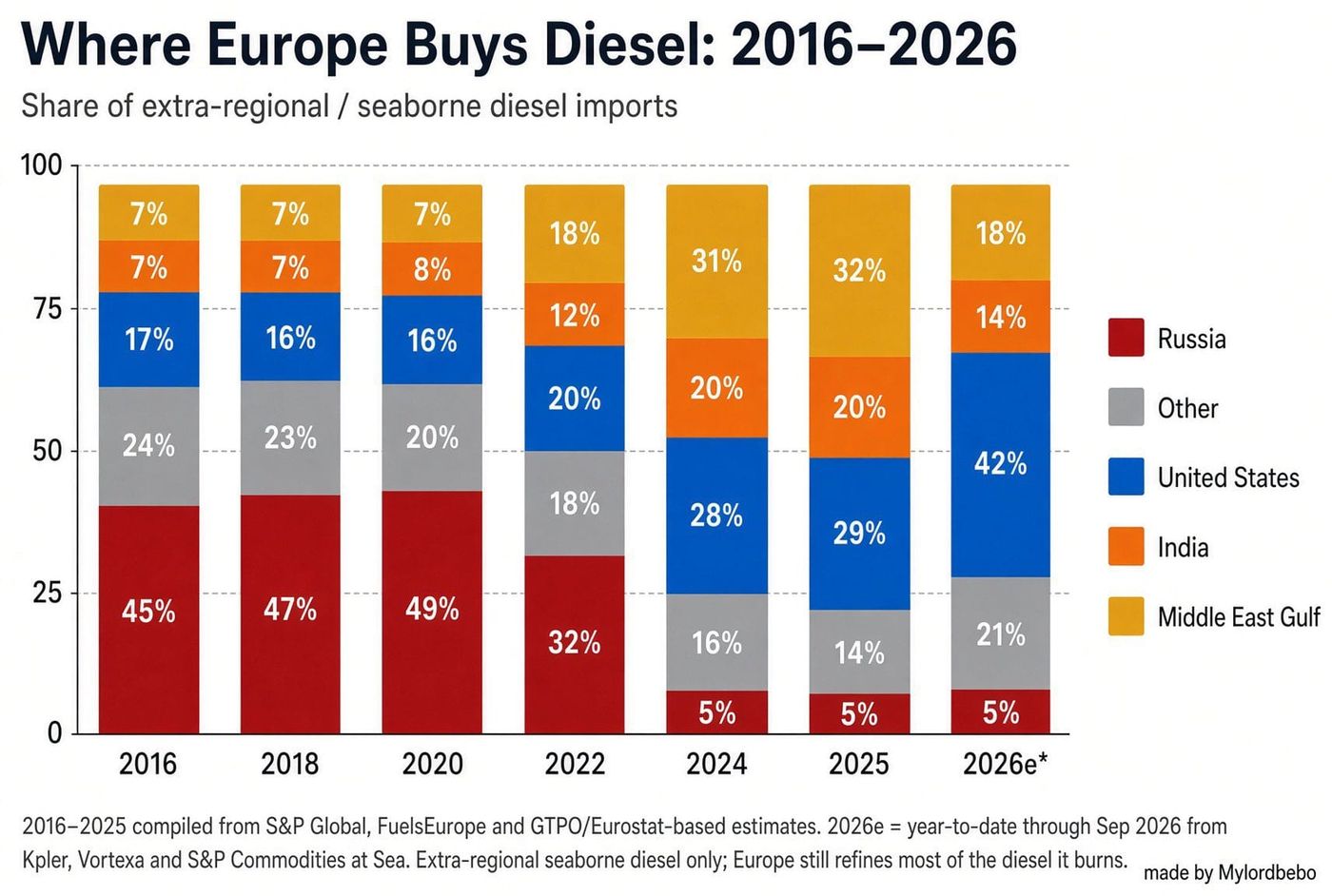
Washington did enforce one deadline this week. Under threat of a ban on American diesel exports, the G7 agreed to release up to 100 million barrels from its reserves over four months. Michael Hudson did the division: "100 million barrels is... one day's overall supply. So, it's not an enormous amount. It's a token amount that they negotiated."¹³ Johnson explained why no release can do more. The strait has been closed since February, and "from middle of April on the world was drawing on its savings account, and by second week of August that savings account was empty."¹⁴ Alexander Mercouris said the purpose plainly: to bring down the price "obviously ahead of the midterm elections in November." Hudson expects the releases to stop working between early November and December. The only date Washington could still impose, then, fell on Europe, and it answers to an inventory curve that nobody in Washington controls.
Saturday the 3rd closed the loop. Saudi Arabia announced a 100,000-man offensive in Yemen, asked Pete Hegseth for American air support and, by the Axios report Nima Alkhorshid relayed, was refused, with Trump and Central Command both opposed.¹⁵ Houthi missiles reached Aramco twice the same day. Jones put the limit of what the fleet could do for Riyadh in a sentence: "A ship is a fool to fight a fort."¹⁶ Aguilar counted the war's age: "We're now 7 months and 5 days into this war. The political goals have not been achieved."¹⁷
“A ship is a fool to fight a fort. All those ships can only do so much on the ground.”
Most of the analysts we track share this reading, and the roster leans that way, so the convergence should be weighed accordingly. The dissent this week came from Charles Finfrock, a former CIA officer, who argued that Iran is the side losing, that "Negotiation time is done"¹⁸ and that the regime cannot survive a Republican midterm, and from Jim Hanson, who thinks Trump has bled Tehran dry and expects an accommodation in the strait rather than a war. Their case rests on the blockade working. The week's evidence, from a tanker hit in a controlled strait to a reserve release sized to an election, is that it is working on everyone's economy at once, which is a different thing.
Why did the calendar slip? The analysts' answer was capacity rather than will. Trump's threats were as loud on 2 October as on the 28th. What changed over the week was how many parties acted as though the threats would not be carried out: Tehran, which let its deadline lapse without fear of reprisal; Riyadh, which asked for cover and did not get it; Europe, which paid in barrels for a reprieve it does not believe in; and Israel's own security establishment, which treated its prime minister's alarm as politics. Jones drew the conclusion for the Gulf: the protection its monarchies bought from Washington "was destroyed in 2026."¹⁹ Johnson drew it for the war: Trump "won't end it. It'll be ended and he'll have to accept the outcome."²⁰





What next week decides
- Aden. Johnson expects Houthi forces to take the city by about 10 October. If they do, the Saudi offensive is over before it begins.
- Iran's answer. Escobar said Tehran would move when it saw Washington preparing something. The Roosevelt is such a sign. Watch whether the deadline that lapsed on 30 September is answered now.
- Netanyahu's window. Three weeks to 27 October. Marandi's reading is that the quiet before the midterms is not Trump's to keep.
- The pump. The diesel release will look like relief for a few weeks. Hudson and Johnson say it fails by early November. The price in the last week of October is the test.
Sources
- Donald Trump, clip played by Daniel Davis, Daniel Davis / Deep Dive · "We have total control of the Hormuz Strait... Last night we had 29 ships come out." · watch ▶ 0:34
- John Mearsheimer, Tom Switzer · "just more bluster by President Trump"; "we're running out of precious munitions" · watch ▶ 4:34
- Daniel Davis, Daniel Davis / Deep Dive · "physical constraints don't give a damn what he says, what words come out of his mouth" · watch ▶ 4:15
- Pepe Escobar, Danny Haiphong · Iran's 45-day ultimatum on the blockade expires Wednesday 30 September; "They would go on the offensive." · watch ▶ 22:23
- Mohammad Marandi, Glenn Diesen · after the Israeli election it is too late for Netanyahu; "what Netanyahu can do is he can start a war" · watch ▶ 6:59
- Trita Parsi, Judging Freedom · "We may now be entering a phase in which the escalation control is essentially lost" · watch ▶ 15:43
- IDF radio, read by Mario Nawfal, Mario Nawfal · "There is no new intelligence warning regarding an imminent attack"; the absence "reinforces the narrative that the alarm was politically motivated" · watch ▶ 6:31
- Daniel Davis, Redacted · "we have been lied to so many times"; "one of these days something true is going to happen and they're going to need you to believe it" · watch ▶ 7:05
- Bobby Jones, Mario Nawfal · "the most powerful warships on this planet cannot go through 21 miles of water" · watch ▶ 63:41
- Larry Johnson, Dialogue Works · "they're not going to be able to sustain combat operations beyond a week, two weeks tops" · watch ▶ 13:59
- John Mearsheimer, Glenn Diesen · "The United States has no interest in escalation" · watch ▶ 0:41
- John Mearsheimer, Glenn Diesen · "I'd bet a lot of money that behind closed doors, the two of them and Trump's other advisers are deeply worried about where this is headed." · watch ▶ 12:43
- Michael Hudson, Dialogue Works · "100 million barrels is, as I said, one day's overall supply... It's a token amount that they negotiated." · watch ▶ 2:35
- Larry Johnson, Dialogue Works · "from middle of April on the world was drawing on its savings account and by second week of August that savings account was empty." · watch ▶ 3:05
- Nima Alkhorshid, relaying Axios, Dialogue Works · Khalid bin Salman asked Hegseth for air support; the US decided against kinetic action · watch ▶
- Bobby Jones, Mario Nawfal · "A ship is a fool to fight a fort." · watch ▶ 23:02
- Anthony Aguilar, Mario Nawfal · "We're now 7 months and 5 days into this war. The political goals have not been achieved." · watch ▶ 1:44
- Charles Finfrock, Mario Nawfal · "I'm not saying negotiate. Absolutely not. Negotiation time is done." · watch ▶ 26:01
- Bobby Jones, Mario Nawfal · the Gulf's "guarantee of protection was destroyed in 2026" · watch ▶ 67:36
- Larry Johnson, Dialogue Works · Trump "won't end it. It'll be ended and he'll have to accept the outcome" · watch ▶ 48:32
By Ruins Report. The Sunday edition reads the week whole, drawing on the seven daily Debriefs linked above. It is a synthesis of what our tracked analysts said, not original reporting. Every quoted claim is sourced, dated and timestamped.
Newsletter
Get the Daily Debrief
One email each morning: what the analysts we track actually said, and every call timestamped to its source. Free.
Free. No spam. View on Substack →
Support the Report
Free to read, every day.
The Debrief is compiled each morning from what the analysts we track actually said, sourced and timestamped. No paywall, no ads, no investors. If it earns a place in your inbox, you can help keep it independent.
Support the report →